How Property Taxes Work on Luxury Homes in Puerto Rico
Learn how property taxes apply to Puerto Rico luxury homes, including Act 60 benefits, assessments, and planning strategies.
.jpg)
Property taxes on Puerto Rico luxury homes run at an effective rate of approximately 1.03% of market value. This calculation typically applies municipal rates between roughly 6.00 and 12.00 mills (0.60% to 1.20%) applied to an assessed value equal to 11.83% of the fair market price. Act 60 Puerto Rico incentives can reduce this burden by up to 75% on qualified real estate, making the island one of the most tax-advantaged jurisdictions in the Caribbean for high-net-worth buyers.
This article breaks down assessment calculations, exemption qualifications, Act 60 benefits, and strategic tax planning for luxury property owners.
Key Takeaways
- Property tax is based on a low assessed value, so effective rates stay relatively low.
- Act 60 can cut property taxes by up to 75% if you qualify.
- Watch CRIM notices, pay on July 1 and January 1, and appeal on time if needed.
- Plan your purchase date, residency rules, and capital gains strategy to avoid mistakes.
Base Property Tax Calculations for Luxury Homes

You calculate your annual property tax by first determining your assessed value. CRIM utilizes a 1957 valuation method, but industry professionals often estimate this assessed value at approximately 11.83% of the current market price for planning purposes. Your municipality then applies its millage rate, typically between 8.03 and 11.83 mills per $1,000 of assessed value.
As a planning example, you can estimate annual tax as:
(Market Value × 0.1183) × (Municipal Rate ÷ 1,000) = Annual Tax, using 11.83% as an illustrative assessment ratio.
The following examples illustrate tax liabilities at three luxury price points. These figures assume the most common municipal rate of 8.70 mills.
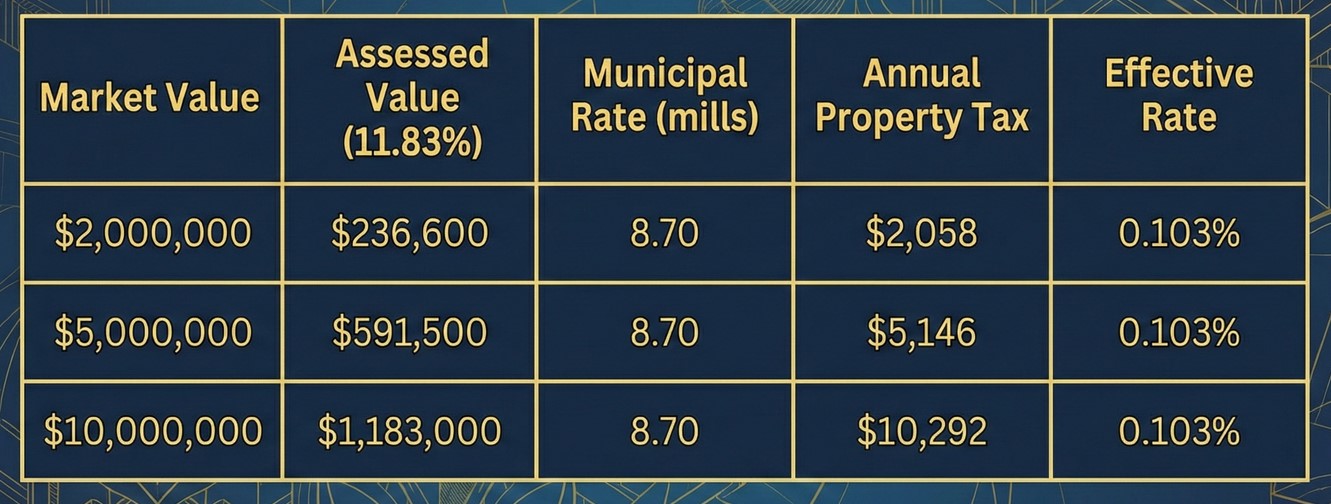
The Municipal Center of Revenue Collection determines your property's fair market value through periodic assessments. CRIM bases this valuation on comparable sales, property characteristics, location, and improvements. CRIM issues property tax bills once a year, with amounts payable in two advance installments that cover each half of the fiscal year.
Property tax rates Puerto Rico vary by municipality, so your exact liability depends on where your luxury home sits. Dorado Beach properties face a different rate than those in Condado or Old San Juan. Verifying the specific municipal rate is essential when budgeting for a purchase.
Act 60 Tax Reduction Strategies
Act 60 Puerto Rico consolidates several tax incentive programs, including the former Acts 20 and 22, into a unified framework designed to attract new residents and businesses. For luxury buyers, Act 60 provisions can offer a 75% property tax exemption, specifically for eligible tourism projects, creative industries, or properties undergoing substantial rehabilitation.
Note: This exemption does not automatically apply to standard personal residences under the Individual Investor decree unless specific rehabilitation or commercial criteria are met.
- These Puerto Rico tax incentives require both a valid Act 60 decree and compliance with bona fide residency and activity requirements; they do not automatically apply to every personal residence owned by an Act 60 individual.
- To qualify for the full suite of Act 60 benefits, you must become a bona fide resident of Puerto Rico. This means spending at least 183 days per year on the island, maintaining your principal residence here, and demonstrating closer connections to Puerto Rico than to any other jurisdiction.
Eligibility Requirements for Property Tax Exemptions
- You must not have been a resident of Puerto Rico for the ten years prior to applying for Act 60 benefits.
- Your property must be your primary residence to claim the individual investor exemption under Chapter 2 of Act 60.
- New construction or properties undergoing substantial rehabilitation (at least 50% improvement in value) qualify for the 75% property tax reduction.
- You need to apply to the Office of Industrial Tax Exemption (OITE) and receive a tax decree before benefits take effect.
- The exemption period typically runs for 15 years from the date of your decree, with possible extensions.
Calculating Your Tax Savings Under Act 60
Let's revisit our earlier examples with Act 60 exemptions applied. Assume you purchase a newly constructed $5 million beachfront villa in Dorado and qualify for the 75% property tax exemption.
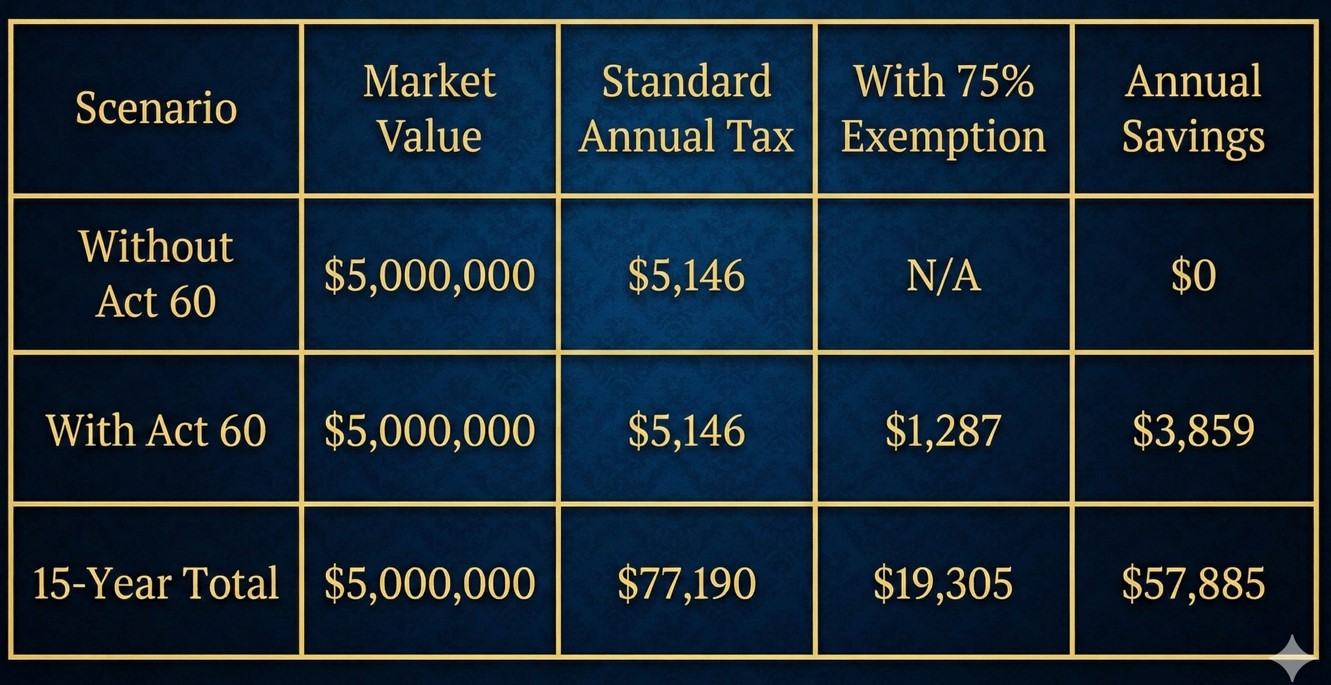
The savings compound over time. For a $10 million property, your 15-year cumulative savings approach $115,000, freeing capital for other investments or lifestyle expenses.
Puerto Rico Property Assessment and Appeals

CRIM uses a 1957 value base with adjustments, so assessed values may be far below market; many guides use an 11.83% ratio to illustrate tax estimates. This archaic system often produces assessed values between 40% and 50% of actual cost, but the 11.83% assessment ratio brings the effective base closer to modern valuations. You should review your assessment notice carefully each year to confirm accuracy.
If you believe CRIM overvalued your luxury home, you have the right to file an appeal. The process requires submitting a formal request within 30 days of receiving your assessment notice, along with supporting documentation such as recent appraisals, comparable sales data, or evidence of property defects.
Steps to Appeal Your Property Assessment
- Obtain a copy of your official CRIM assessment notice, which arrives by mail in the first quarter of the tax year.
- Gather evidence: hire a licensed appraiser to produce an independent valuation, compile recent sales of comparable luxury properties, and document any property damage or issues that reduce value.
- Complete CRIM's appeal form (available online or at municipal offices) and attach all supporting documents.
- Submit your appeal within the 30-day window; late filings face automatic rejection.
- Attend the scheduled hearing with CRIM's review board, presenting your case with professional documentation.
- Receive a written decision; if denied, you may escalate to Puerto Rico's Tax Court for further review.
Successful appeals have been known to reduce assessed values by 10% to 20%, translating to meaningful annual savings. The key lies in professional appraisals and thorough documentation.
Payment Schedules, Penalties, and Compliance

Puerto Rico splits real property taxes into two advance installments each year.
- Standard statutory tax deadlines are July 1 and January 1. However, CRIM often issues bills later in the year, effectively shifting payment windows (e.g., to September and March); always adhere to the specific due date listed on your official notification.
- The second installment covers January 1 through June 30 and must be paid by January 1. CRIM sends bills approximately 30 days before each due date, and you can pay online, by mail, or in person at authorized banks.
Late payments trigger surcharges and interest that add up quickly. CRIM applies
- A 5% surcharge after 30 days
- 10% after 60 days, and
- 15% after 90 days
- Plus 10% annual interest on the unpaid balance
For a $10,000 annual tax bill, allowing the balance to remain unpaid for several months can add hundreds of dollars in surcharges and interest, so it is important to pay as close to the due date as possible.
Avoiding Common Compliance Pitfalls
- Set calendar reminders for June 15 and December 15 to ensure you pay before the July 1 and January 1 deadlines.
- Enroll in CRIM's online portal to receive electronic notices and make payments directly from your bank account.
- If you finance your luxury home, confirm whether your lender includes property taxes in escrow; many Puerto Rico banks do not, leaving payment responsibility entirely with you.
- Keep copies of all payment receipts and assessment notices in a dedicated tax file for at least seven years.
- If you rent your property, keep in mind that short-term rental income may affect your eligibility for certain residential exemptions.
Working with a local accountant familiar with Puerto Rico real estate tax benefits is highly recommended—and using a tax summary as a starting reference—to ensure you remain compliant while maximizing available deductions and exemptions.
Comparative Analysis: Puerto Rico vs. Mainland States
How do Puerto Rico's property taxes stack up against high-net-worth havens on the U.S. mainland? The island offers compelling advantages, especially when you factor in Act 60 incentives and the absence of state income tax—recent market trends also show how demand shifts in luxury segments.
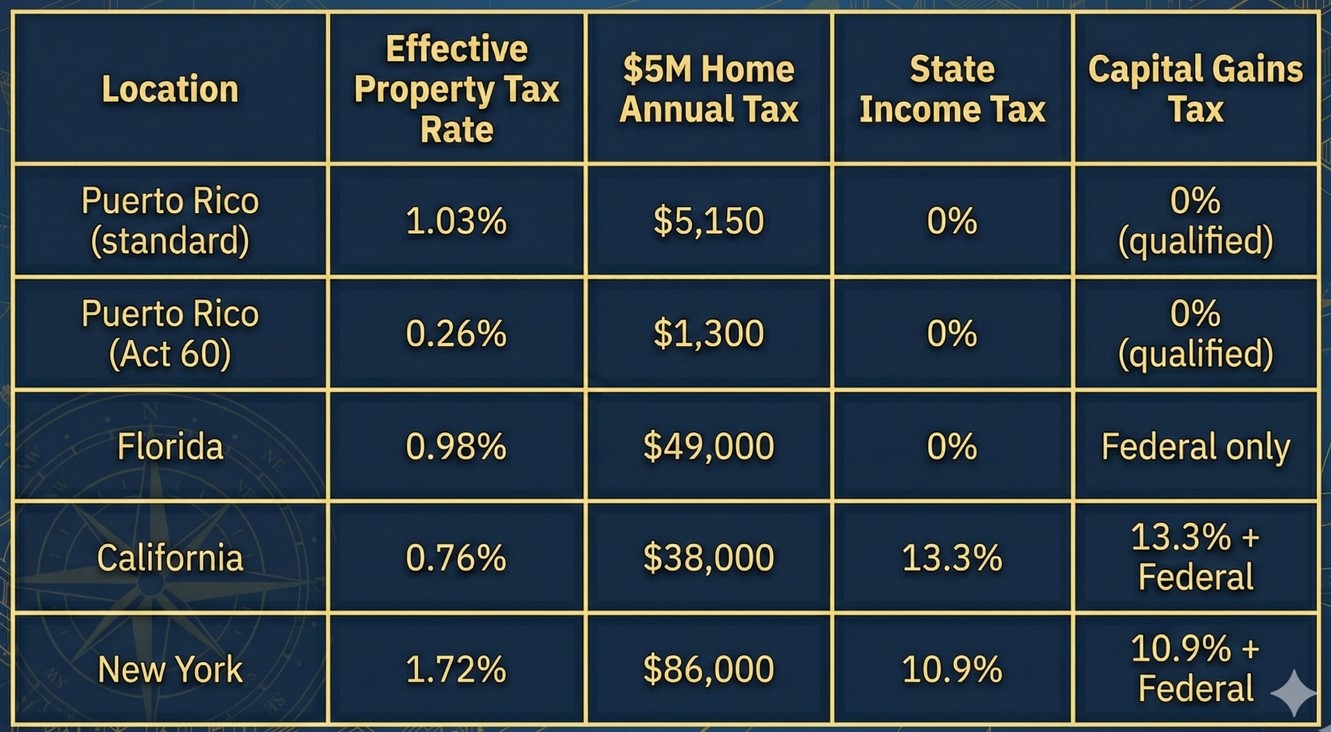
The table shows that even without Act 60, Puerto Rico's property taxes remain competitive with Florida's and far below New York's. When you layer in the 75% exemption, the island becomes the clear winner for luxury property owners. Capital gains tax Puerto Rico real estate rules further sweeten the deal: qualified Act 60 residents pay 0% on gains accrued after establishing residency, compared to combined federal and state rates exceeding 30% in California.
You also avoid state income tax entirely in Puerto Rico. For high earners relocating from New York or California, the combination of low property taxes, zero state income tax, and favorable capital gains treatment can yield total tax savings that exceed $500,000 annually on $5 million in income.
Tax Exemptions for Puerto Rico Luxury Homes

Beyond Act 60, several other property tax exemptions apply to luxury homeowners in Puerto Rico. The most common include exemptions for veterans, senior citizens, and properties designated as historic landmarks. These tax exemptions Puerto Rico luxury homes owners should explore can stack with Act 60 benefits in certain cases, though restrictions apply.
Veterans with service-connected disabilities receive property tax exemptions ranging from 50% to 100%, depending on the disability rating. Senior citizens aged 65 and older qualify for a partial exemption if their household income falls below specified thresholds, though most luxury homeowners exceed these limits.
Historic Property Designations
If your luxury home sits in Old San Juan or another historic district, you may qualify for property tax relief under Puerto Rico's historic preservation incentives.
- Properties listed on the National Register of Historic Places or designated by the Puerto Rico State Historic Preservation Office receive up to 50% reductions on property taxes for ten years, provided you maintain the structure according to preservation standards. This benefit applies separately from Act 60, so you can potentially combine both programs if your property qualifies.
- Investors who restore colonial-era mansions in Old San Juan have successfully secured both historic preservation exemptions and Act 60 benefits, reducing their effective property tax rate to less than 0.15%. The application process requires architectural plans, preservation commitments, and approval from multiple agencies, but the long-term savings justify the effort.
Strategic Timing for Luxury Property Purchases

When you close on a luxury home in Puerto Rico affects your property tax liability and your ability to claim Act 60 benefits. CRIM assesses property taxes based on ownership as of January 1 each year, so purchasing before year-end means you owe the full year's taxes, while closing in early January shifts the prior year's liability to the seller.
For Act 60 purposes, you want to establish residency as early in the calendar year as possible. Your tax decree takes effect from the date of approval, and you must meet the 183-day residency requirement within that first year to claim benefits. Closing on a property in January or February gives you the full year to satisfy residency requirements and maximize your first-year tax savings.
Coordinating Purchase and Residency Timelines
- Begin your Act 60 application process at least three to six months before closing on your luxury property.
- Schedule your closing for early in the calendar year (January or February) to align with CRIM's assessment cycle and give yourself maximum time to establish residency.
- Move personal belongings, register vehicles, obtain a Puerto Rico driver's license, and open local bank accounts within the first 60 days of closing.
- Track your days on the island meticulously using travel records, credit card statements, and a physical calendar to prove you meet the 183-day threshold for audit readiness.
- File your first Puerto Rico tax return on time, declaring your new residency status and claiming all applicable exemptions.
Coordination with tax advisors and attorneys ensures that purchase timelines align with broader tax planning strategies. A few weeks' difference in closing date can mean tens of thousands of dollars in tax savings over the first year.
Capital Gains Considerations for Luxury Real Estate

Capital gains tax Puerto Rico real estate transactions follow different rules depending on your residency status and when you acquired the property. Act 60 residents enjoy a 0% capital gains tax rate on appreciation that occurs after they establish bona fide residency, but gains accrued before moving to Puerto Rico remain subject to federal tax.
For example, consider a beachfront estate purchased in Dorado for $3 million in 2020 while living in New York, then moved to Puerto Rico in 2023 under Act 60 and sold the property in 2026 for $6 million. You owe federal capital gains tax on the appreciation from $3 million to the fair market value on your residency date (perhaps $4.5 million), but the gain from $4.5 million to $6 million escapes both federal and Puerto Rico tax under Act 60.
Strategies to Minimize Capital Gains Exposure
- Obtain a professional appraisal on the date you establish Puerto Rico residency to document the property's fair market value and separate pre-residency gains from post-residency appreciation.
- Consider a Section 1031 like-exchange before relocating to defer federal gains, then establish residency and hold the replacement property long-term to benefit from Act 60's 0% rate on future appreciation.
- If you own multiple properties, prioritize moving your primary residence to Puerto Rico first, then gradually transition investment properties to take advantage of the favorable capital gains treatment.
- Coordinate with a tax advisor who understands both federal and Puerto Rico tax codes to model different scenarios and identify the optimal timing for sales.
The interplay between federal tax obligations and Puerto Rico real estate tax benefits requires careful planning. Connecting with experienced tax professionals who specialize in Act 60 structuring allows investors to capture every available advantage.
Decision-Making Framework for Tax-Focused Buyers

Before pursuing Act 60 for a luxury home, consider whether your income, travel schedule, and property plans support the 183‑day residency rule and other bona fide residency tests tied to the decree. Focus on whether the property is new construction or will undergo substantial rehabilitation, how long you expect to hold it, and whether potential property tax exemptions and municipal tax reductions justify the compliance and documentation required.
Use a simple checklist—qualifying income that can be Puerto Rico‑sourced, ability to reside on the island most of the year, a qualifying property type, and willingness to work with specialized tax counsel—to decide if Act 60’s property-tax and capital-gains benefits meaningfully outweigh the complexity for your situation.
- Income Level: Do you earn at least $200,000 annually from sources that can be Puerto Rico-sourced (business income, capital gains, dividends)? Act 60 delivers the greatest benefit to high earners.
- Residency Flexibility: Can you spend at least 183 days per year in Puerto Rico without disrupting your career or family obligations? The residency requirement is non-negotiable.
- Property Type: Are you purchasing new construction or planning substantial rehabilitation (50%+ improvement)? These qualify for the 75% property tax exemption.
- Investment Horizon: Do you plan to hold the property for at least five years? Act 60 benefits compound over time, and short-term ownership reduces total savings.
- Professional Support: Are you willing to work with specialized tax advisors and attorneys to structure your move correctly? Missteps can disqualify you from benefits.
If you answer yes to most of these questions, Act 60 likely makes financial sense. For a high-earning professional purchasing a $5 million luxury home, the combination of property tax savings, income tax elimination, and capital gains advantages can exceed $100,000 annually.
Puerto Rico Luxury Properties for Sale
If you're ready to explore luxury properties for sale that qualify for Act 60 benefits and offer the lifestyle you desire, we invite you to review our current featured listings. Each property represents the pinnacle of Puerto Rico real estate, combining architectural excellence, prime locations, and strong investment fundamentals. Christie's International Real Estate Puerto Rico curates these opportunities exclusively for discerning buyers who value privacy, quality, and strategic tax advantages.

Dorado, Puerto Rico Private Address
This exceptional beachfront estate in Dorado offers direct ocean access, resort-style amenities, and new construction that qualifies for Act 60's 75% property tax exemption. The property features six bedrooms, a chef's kitchen, infinity pool, and lush tropical landscaping across more than an acre of prime coastal land.

223 Rosario #223, San Juan, PR 00912
Located in the heart of Old San Juan, this meticulously restored colonial residence combines historic charm with modern luxury finishes. The property spans 3,500 square feet across three levels, with original hardwood floors, soaring ceilings, and a private rooftop terrace overlooking the bay.
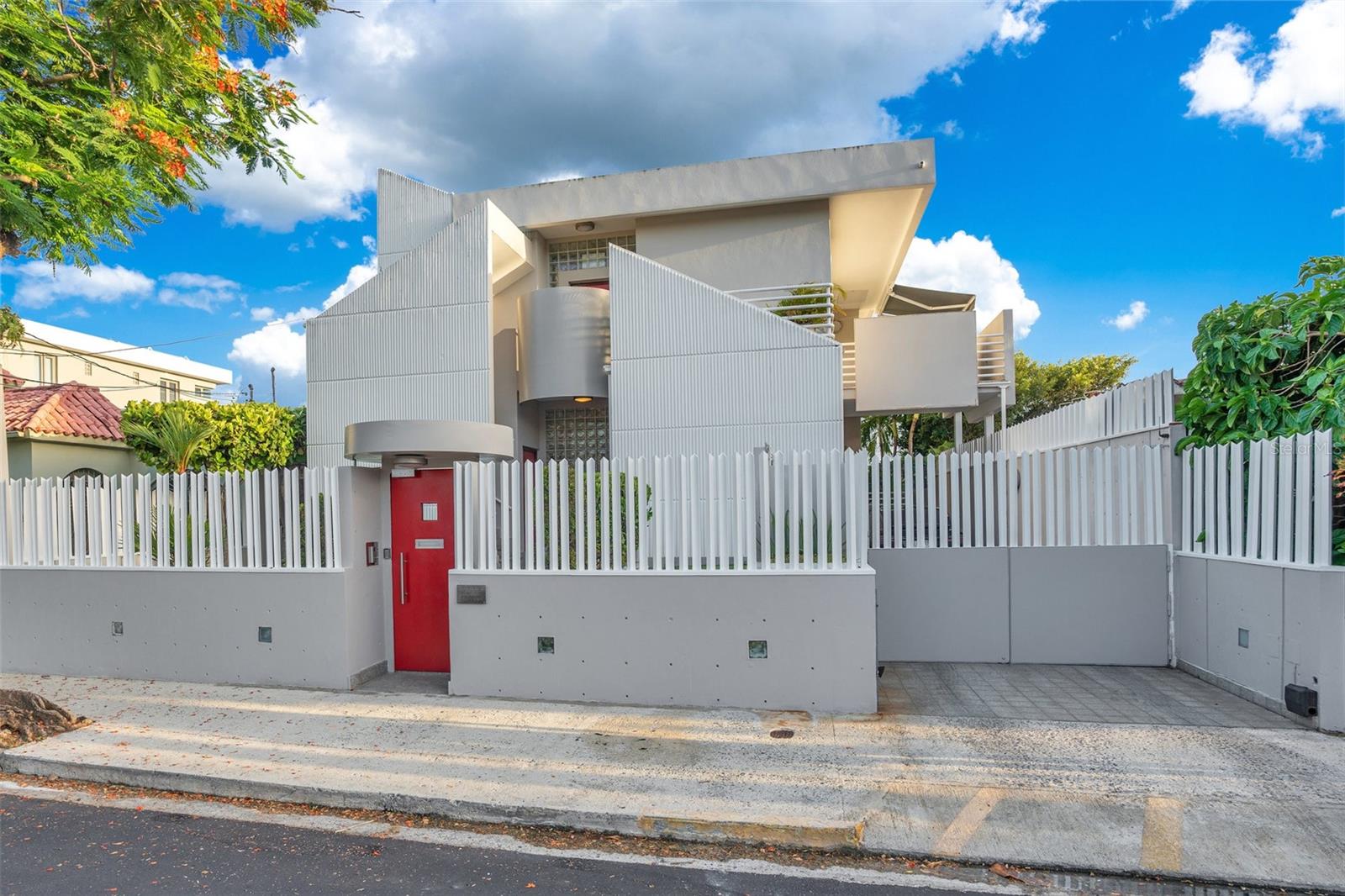
2008 España St San Juan PR, 00911
This contemporary masterpiece in Condado delivers oceanfront living with five bedrooms, floor-to-ceiling windows, and a private pool just steps from the beach. The open-concept design maximizes natural light and ocean breezes, while high-end finishes and smart-home technology provide every modern convenience.

BO Flamenco Las Quintas Solar 15, Culebra PR, 00775
For those seeking ultimate privacy, this Culebra property offers a rare opportunity to own land in one of the Caribbean's most pristine locations. The parcel sits minutes from Flamenco Beach, consistently ranked among the world's best, with development potential for a custom luxury retreat.
Final Thoughts
Puerto Rico’s luxury-home tax equation rewards owners who understand the assessment ratio, municipal millage, and CRIM’s billing cycle—and who proactively structure their purchase around exemptions, appeals, and compliance. When Act 60 is layered correctly, the savings can compound over the years, improving cash flow and preserving capital for lifestyle upgrades or additional investments. The difference between “good” and “optimal” outcomes often comes down to timing, documentation, and working with experienced local professionals who can align real estate decisions with broader tax strategy.
At Christie's International Real Estate Puerto Rico, we help clients buy, sell, and rent out Puerto Rico luxury properties with a clear plan for taxes, incentives, and long-term value. If you want expert guidance on Act 60 alignment, CRIM considerations, and finding the right property (or the right buyer/tenant), we’re ready to help. Connect with us and schedule a private consultation today.
FAQs
What is Rule 60 in Puerto Rico?
Act 60 (Puerto Rico’s “Incentives Code”) is a consolidated set of tax incentive programs (it folded multiple older incentive laws into one framework). Depending on the specific chapter/decree, Act 60 can offer benefits such as preferential income tax rates for qualifying businesses/activities and exemptions/reductions on certain Puerto Rico taxes (e.g., municipal taxes and, in some cases, property taxes tied to qualifying projects).
Why do rich people buy houses in Puerto Rico?
Most high-net-worth buyers cite a mix of tax strategy + lifestyle + jurisdiction advantages, including:
- Potential tax incentives (when they legitimately qualify and document bona fide residency properly).
- Relatively favorable property-tax structure (millage applied to assessed value, which may be a fraction of market value, depending on the CRIM assessment).
- Coastal luxury lifestyle (Dorado/Condado-style markets), plus proximity to the mainland U.S. with U.S. currency and federal framework as a U.S. territory.
Where do most American expats live in Puerto Rico?
There isn’t one official list, but the most commonly cited expat hubs (especially for higher-end buyers and relocators) include:
- San Juan metro (Condado / Ocean Park / Old San Juan): The San Juan metro blends walkable beachfront living, historic architecture, and vibrant dining and nightlife, making it the most urban and cosmopolitan area for expats and luxury buyers.
- Dorado: Dorado is known for gated resort-style communities, beachfront estates, and family-friendly amenities, particularly around Dorado Beach Ritz-Carlton Reserve.
- Palmas del Mar: Palmas del Mar is a master-planned resort community offering golf courses, marinas, private schools, and self-contained luxury living on Puerto Rico’s east coast.
- Rincón: Rincón attracts buyers seeking a relaxed west-coast lifestyle, surf culture, sunsets, and lower-density luxury homes with strong lifestyle appeal.
- Guaynabo: Guaynabo offers upscale suburban living close to San Juan, favored for its private neighborhoods, top schools, and easy access to business districts.
How do you calculate property tax on a luxury home in Puerto Rico?
In general, the bill is driven by CRIM’s assessed value and your municipality’s millage rate (rates vary by municipality). Many explain it as:
Annual property tax ≈ Assessed Value × (Municipal Millage Rate), with millage commonly cited around 8.03 to 11.83 mills (per $1,000 of assessed value).
Because assessment practices can be complex (and may not track market value dollar-for-dollar), buyers typically verify the CRIM record, the municipal rate, and any applicable exemptions before final budgeting.
When are CRIM property tax payments due—and what should owners do to avoid issues?
Common guidance is that real property tax is payable semiannually in advance, due July 1 and January 1 (and there may be early-payment discounts depending on the period and CRIM notices).
Best practice for luxury owners:
- Confirm the exact due dates on your current CRIM bill/portal notice
- Save receipts and CRIM notices for your tax file
If the assessment looks wrong, prepare documentation early (appraisal/comps) so you can challenge it within the allowed window.