If you are buying or renting a luxury property in Puerto Rico and you have pets, the rules are more layered than most buyers expect. Puerto Rico condo pet policy varies building by building, but territorial law adds a separate layer that no HOA rule can override. Before you sign a lease or close on a unit, you need to understand exactly where your pet stands legally and practically.
In this article, you will find a structured breakdown of condo restrictions, breed limits, deposits, service animal considerations, and the best high-end veterinary and boarding options on the island.
Key Takeaways
- Condo pet rules vary by building and must be checked before you commit.
- Puerto Rico’s territorial pet laws can override HOA preferences for restricted breeds.
- Service animals and ESAs may qualify for housing accommodations.
- Pet deposits, rent, and damage liability can add real costs.
- Luxury buyers should verify vet, boarding, and neighborhood pet support in advance.
What Puerto Rico Condo Pet Policies Actually Require
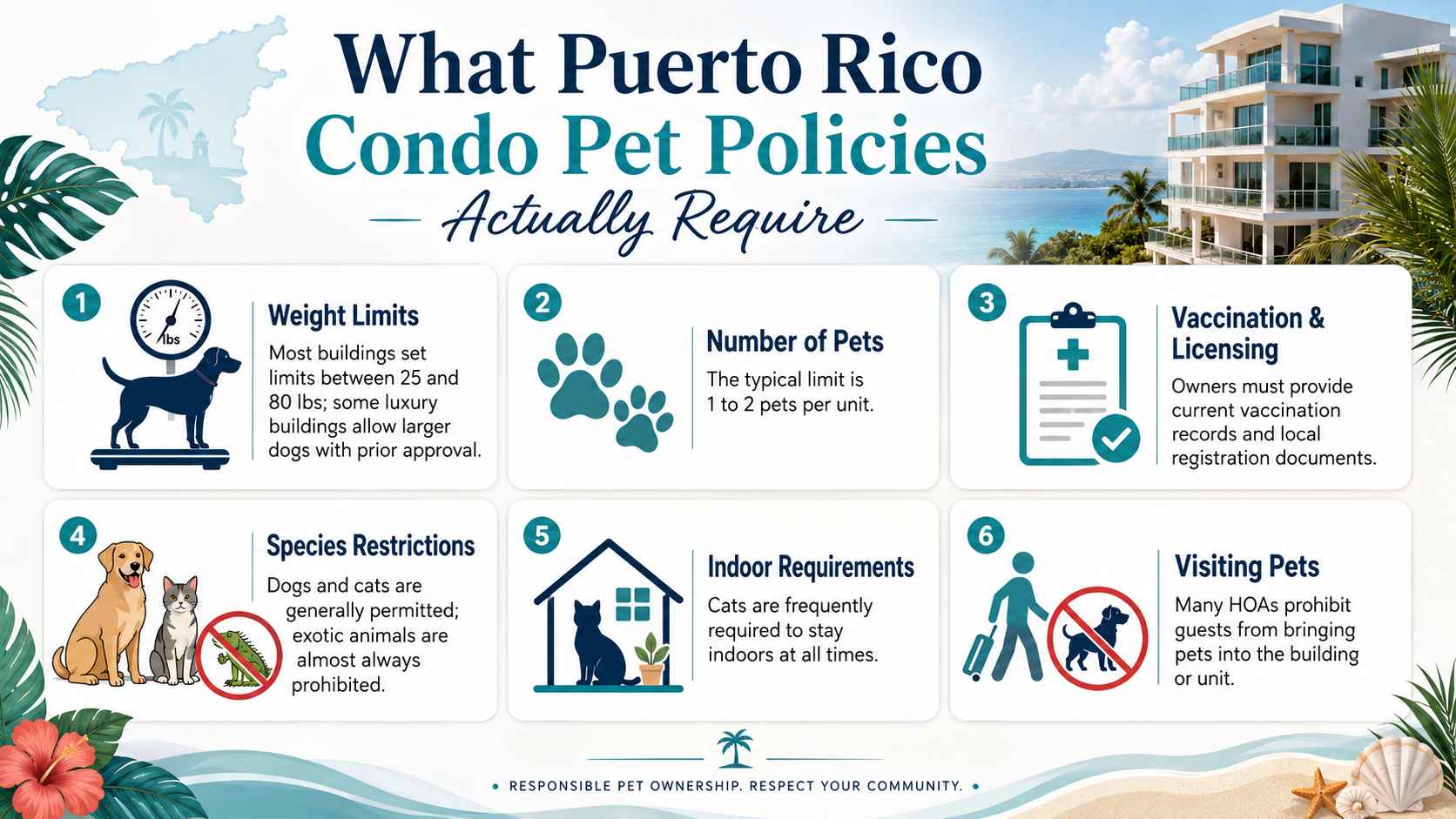
Many condos and luxury rentals allow pets, but the conditions vary widely by building and are usually enforced through written governing documents. Property managers commonly impose:
- Weight limits (vary by building): many condo policies set limits of 20, 25, 40, 50, or 60 pounds, depending on the property.
- Cap the number of pets per unit, and
- Requires proof of current vaccinations and local licensing.
Each building sets its own rules, so two condos on the same street in Condado can have completely different standards.
Beyond weight and number limits, many buildings also restrict permitted species to dogs and cats only, require cats to remain indoors, and prohibit visiting or boarding pets in the unit.
Common Condo Pet Policy Requirements
- Weight limits: Most buildings set limits between 25 and 80 lbs; some luxury buildings allow larger dogs with prior approval.
- Number of pets: The typical limit is 1 to 2 pets per unit.
- Vaccination and licensing: Owners must provide current vaccination records and local registration documents.
- Species restrictions: Dogs and cats are generally permitted; exotic animals are almost always prohibited.
- Indoor requirements: Cats are frequently required to stay indoors at all times.
- Visiting pets: Many HOAs prohibit guests from bringing pets into the building or unit.
Pet Deposits and Pet Rent
Many pet-friendly condos may require a pet deposit, registration fee, or other pet-related charge, but the amount and structure depend on the building (and they add a real cost to your move-in budget). Some buildings charge a one-time non-refundable fee, others require a refundable deposit, and some charge monthly pet rent on top of your base rent or HOA fees.
- One-time non-refundable fee: Typically ranges from $200 to $500 per pet.
- Refundable deposit: Often equivalent to one month's rent or a fixed amount tied to the unit's value tier.
- Monthly pet rent: Some buildings charge $25 to $75 per month per pet in addition to other fees.
- Damage liability: Most HOA pet rules include a clause holding the owner financially responsible for any damage caused by the animal.
Always request the full pet addendum in writing before signing any lease or purchase agreement. Verbal confirmations from building staff do not protect you if a dispute arises later.
Breed Restrictions Puerto Rico: What the Law Actually Says
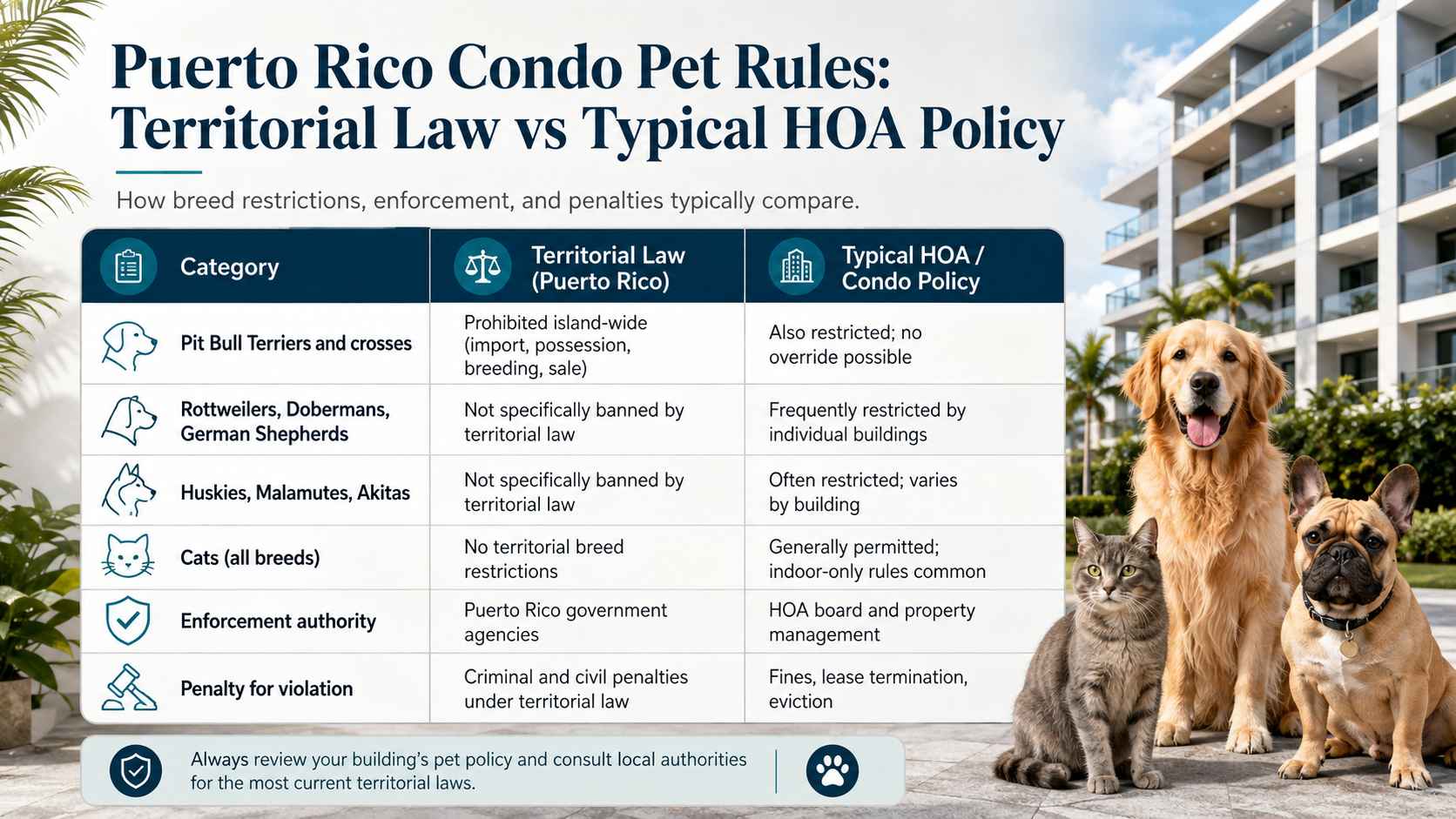
Breed restrictions in Puerto Rico go beyond what a typical HOA pet rules document covers. Under Puerto Rico territorial law, Pit Bull Terriers and their crosses remain prohibited from import, possession, breeding, buying, selling, or transfer on the island. A partial relaxation occurred in 2018, but the core prohibition remains active and enforceable at the territorial level, which means it applies regardless of what any individual condo's pet policy says.
This is one area where buyers sometimes get caught off guard, especially those relocating from U.S. states where breed-specific legislation has been repealed or never existed.
Breeds Commonly Restricted by Condos and HOAs
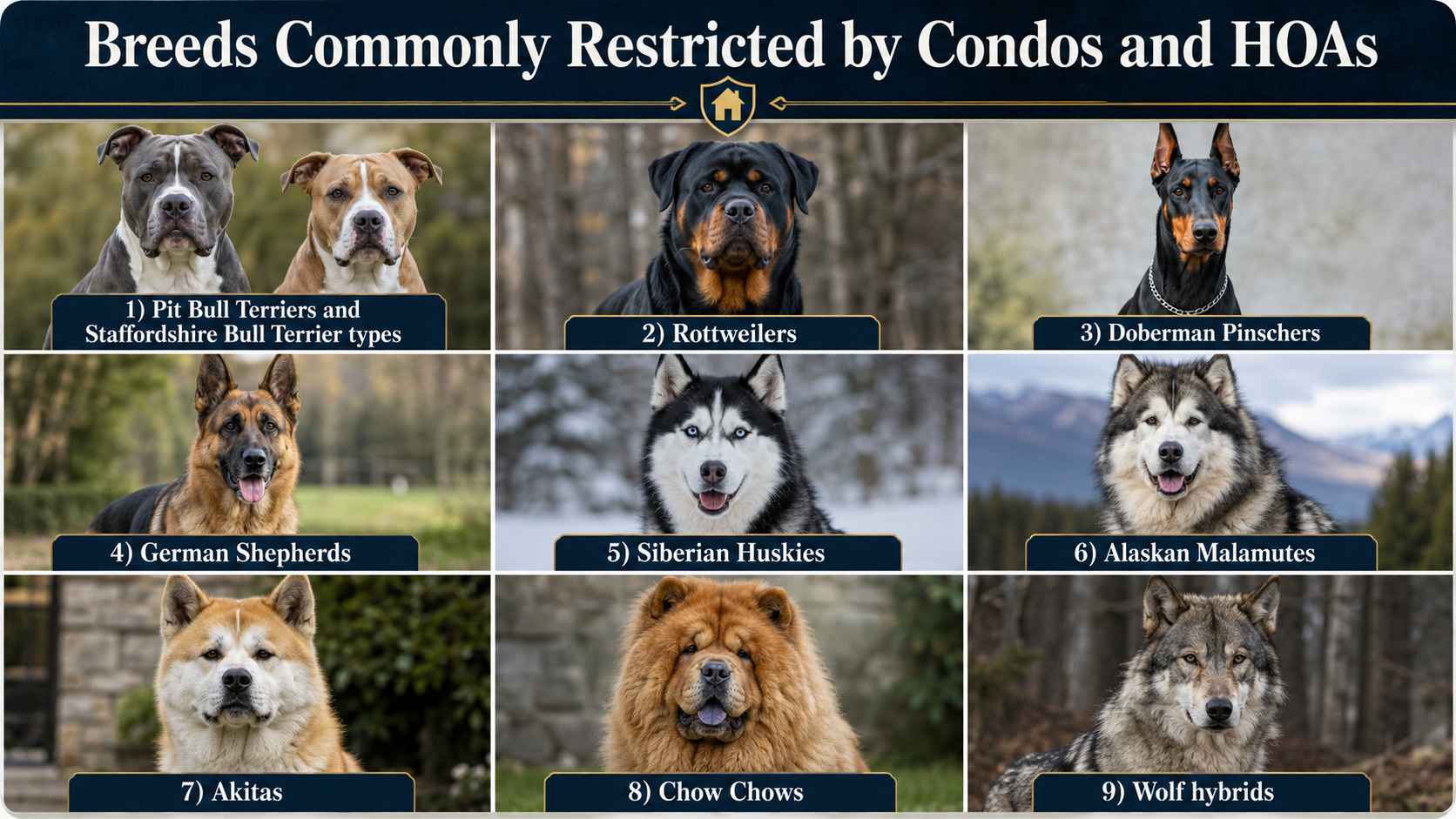
Beyond the territorial law, most luxury condo buildings maintain their own breed restriction lists. These lists typically include:
- Pit Bull Terriers and Staffordshire Bull Terrier types (also prohibited by territorial law)
- Rottweilers
- Doberman Pinschers
- German Shepherds
- Siberian Huskies
- Alaskan Malamutes
- Akitas
- Chow Chows
- Wolf hybrids
If your dog's breed appears on this list, you need legal advice before committing to a property in Puerto Rico. Breed restrictions Puerto Rico are not just a condo policy issue — for certain breeds, they are a matter of territorial law.
Comparison Table: Territorial Law vs. HOA Breed Restrictions
Service Animals and Emotional Support Animals in Puerto Rico
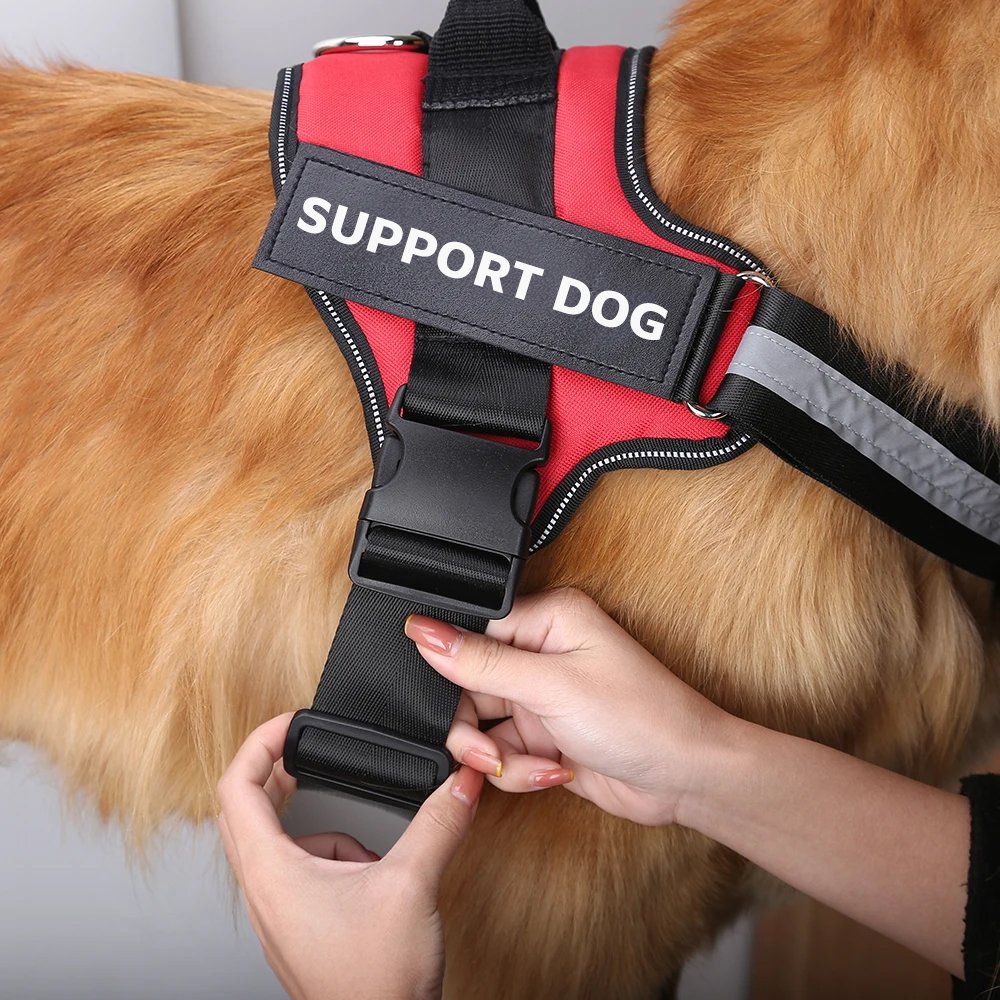
Service animals and emotional support animals occupy a different legal space than regular pets, and that distinction matters when you are dealing with HOA pet rules. Under federal fair-housing and disability frameworks, properly documented service animals and emotional support animals are generally exempt from private condo restrictions on size, number, and breed. Under fair-housing guidance, assistance animals are not subject to ordinary pet fees or deposits, and housing providers must evaluate accommodation requests under the applicable disability rules.
That said, the exemption has real limits that buyers and renters need to understand clearly.
What ESA and Service Animal Protections Cover
- Exemption from weight and size limits set by the HOA.
- Exemption from breed restrictions in the condo's own pet policyNo pet deposits or pet rent charges allowed.
- Housing providers can request reasonable documentation from a licensed healthcare provider.
- Individualized assessments are permitted if the animal poses a direct threat.
What ESA Protections Do Not Cover
- Emotional support animals may receive housing accommodations under federal fair-housing rules, but they must still comply with any applicable health, safety, and documentation requirements, and private condo rules may still impose lawful building-level restrictions.
- Service animals Puerto Rico must meet the federal ADA definition (trained to perform specific tasks) to receive the strongest legal protections.
- Documentation requirements are real — a letter from an online service with no clinical relationship may not satisfy a housing provider's reasonable documentation request.
- The exemption applies to housing, not to common areas or amenities where the building may enforce separate rules.
If you rely on a service animal or ESA, consult with a Puerto Rico-licensed attorney before purchasing or leasing a unit. The intersection of federal protections and territorial law is genuinely complex here.
Moving Your Pet to Puerto Rico: Entry Requirements and Local Support
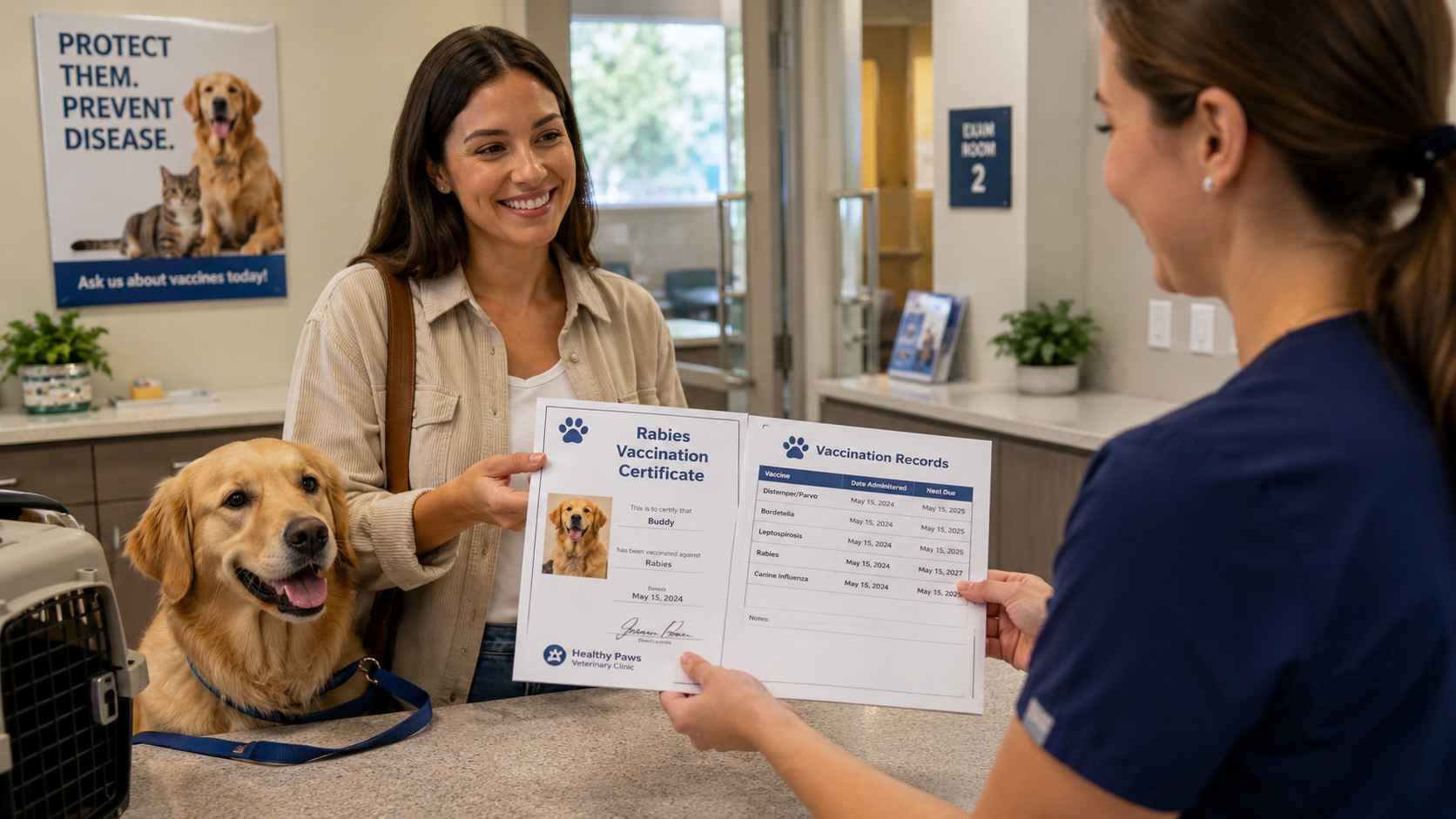
Relocating to Puerto Rico with a pet is generally straightforward compared to international moves, but it still requires planning. Recent relocation guidance describes Puerto Rico as a domestic move for pets coming from the U.S. mainland, but owners should still confirm current entry, inspection, and document requirements before travel. You do need to have current health certificates, vaccination records, and, in some cases, a USDA-accredited veterinarian's health certification completed within a specific window before travel.
Once you arrive, lining up local veterinary services Puerto Rico early is a practical priority, not an afterthought.
Pre-Arrival Checklist for Pet Owners
- Confirm your pet's breed is not prohibited under Puerto Rico territorial law.
- Schedule the health examination within the timing required by your airline and the current Puerto Rico entry guidance; recent relocation sources describe health certificates issued within 72 hours to 10 days of travel depending on the rule set used.
- Obtain a current rabies vaccination certificate and any other required vaccination records.
- Check airline-specific pet travel policies, as carrier rules vary significantly.
- Research local veterinary clinics in your destination neighborhood before you land.
- Identify a luxury pet boarding Puerto Rico option in case your move-in timeline shifts.
- Request the full pet policy from your building before finalizing your move date.
High-End Veterinary and Luxury Pet Boarding Options in Puerto Rico

Pet-friendly luxury living in Puerto Rico is more practical today than it was even five years ago, partly because the island's veterinary and boarding infrastructure has grown alongside its luxury real estate market. The San Juan metro area — including Condado, Miramar, and Santurce — offers veterinary and boarding options, but buyers should verify a clinic's credentials, emergency coverage, bilingual support, and service standards before choosing a neighborhood. For buyers considering Puerto Rico luxury real estate, proximity to quality pet services is a legitimate factor worth evaluating alongside school districts and commute times.
Luxury pet boarding Puerto Rico options range from standard kennels to boutique facilities that offer private suites, grooming, training, and even pet transport coordination.
What to Look for in a Luxury Veterinary Practice
- Board-certified specialists in internal medicine, surgery, or dermatology.
- 24-hour emergency services or a clear after-hours referral protocol.
- Bilingual staff (English and Spanish) for clear communication.
- Modern diagnostic equipment including digital X-ray and ultrasound.
- Experience with international relocators and travel health documentation.
What to Look for in a High-End Boarding Facility
- Private suites rather than shared kennels.
- Climate-controlled environments — important given Puerto Rico's heat and humidity.
- On-site or on-call veterinary staff.
- Daily exercise, enrichment, and socialization programs.
- Webcam or photo update options for owners traveling internationally.
- Grooming and training services available during the stay.
- Transparent pricing with no hidden fees.
Perhaps the most practical advice here is to visit any boarding facility in person before your pet stays there. Photos on a website tell you very little about how a facility actually operates.
Evaluating Pet Policies Before You Buy or Rent

Buyers focused on Puerto Rico luxury real estate sometimes treat pet policies as a secondary concern, something to sort out after the deal closes. That approach creates real risk. HOA pet rules are part of the binding governing documents of a condominium, and violations can result in fines, forced removal of the pet, or even lease termination in rental situations.
The right time to review pet policy is during due diligence, not after move-in.
Due Diligence Steps for Pet-Owning Buyers
- Request the full HOA governing documents, including the pet policy addendum and any recent amendments.
- Confirm your pet's breed, weight, and species against the building's specific restrictions — not just the general policy summary.
- Ask directly whether the building has ever granted exceptions and under what conditions.
- Verify whether the building allows emotional support animals and what documentation they require.
- Confirm the exact pet deposit amount, whether it is refundable, and any ongoing monthly pet fees.
- Check whether the building has outdoor pet relief areas or designated walking routes.
- Ask about noise complaint history related to pets in the building — this affects your daily experience.
Your real estate agent should pull this information for you as a standard part of the transaction. If they are not raising it proactively, ask directly.
Puerto Rico Luxury Properties for Sale
Finding a property that fits both your lifestyle and your pet's needs takes local expertise and access to the right inventory. Christie's International Real Estate Puerto Rico specializes in connecting buyers with luxury properties for sale across the island's most sought-after markets, from Dorado's gated communities to Old San Juan's historic residences. If pet-friendly luxury living is a priority for you, the team at Christie's International Real Estate Puerto Rico can identify buildings and estates where the rules work in your favor from day one.
Below are four current listings that represent the range of Puerto Rico luxury real estate available right now.

366 Dorado Beach East, Dorado, PR 00646
This exceptional Dorado Beach East residence sits within one of Puerto Rico's most prestigious gated communities, offering direct access to world-class amenities and resort-style living. The property combines generous indoor and outdoor space, making it a strong option for buyers who want room for pets alongside high-end finishes.
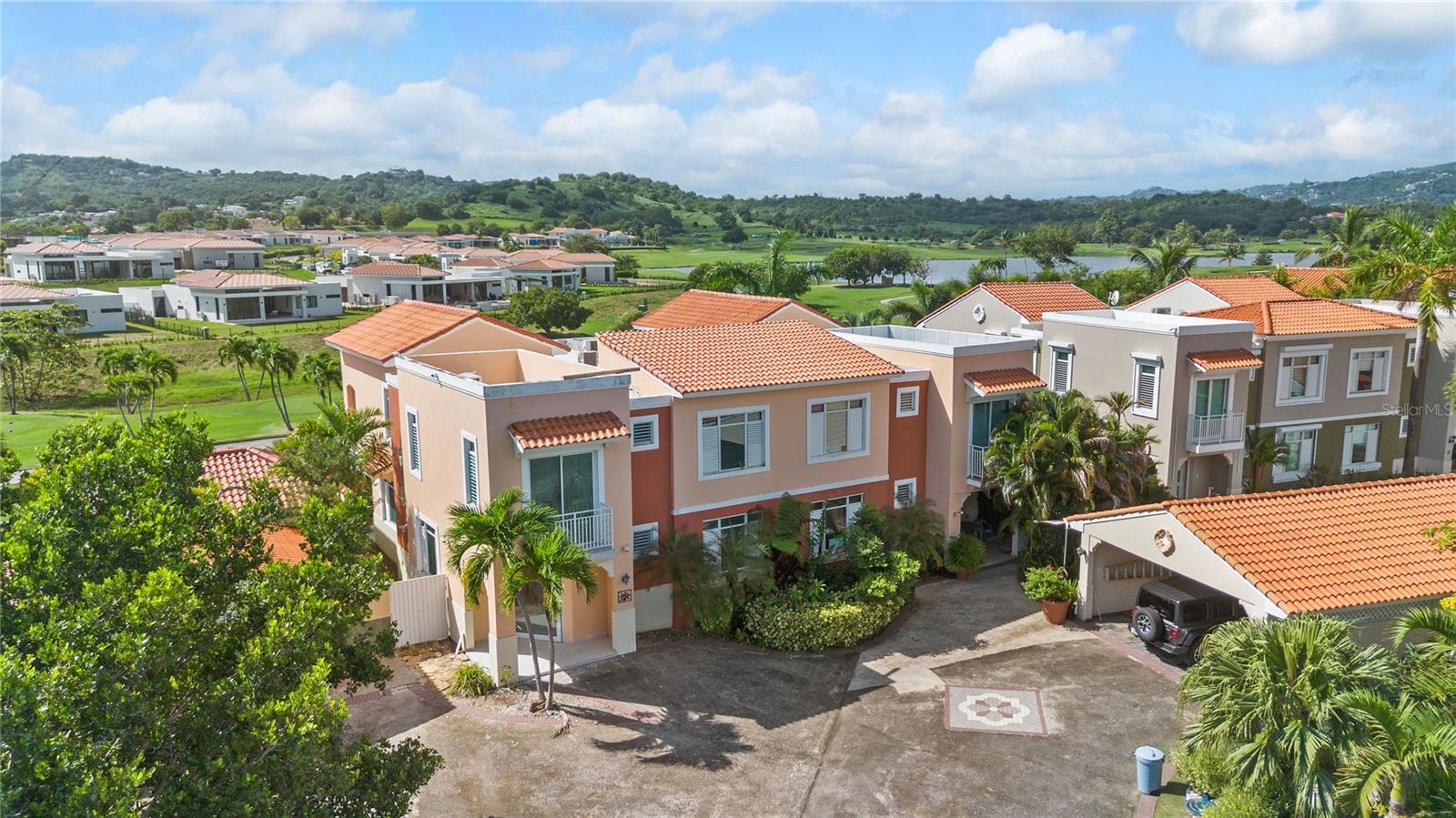
30 Flamboyan Greens, Humacao, PR 00791
Set within the Palmas del Mar community in Humacao, this property delivers a quieter coastal lifestyle with access to golf, marina, and beach facilities. The community's layout and lot sizes give pet owners more flexibility than a high-rise condo environment typically allows.

Lot 4 Ibiza St, RD 107 KM 2.7, Aguadilla, PR 00603
This land parcel in Aguadilla offers a rare opportunity to build a custom luxury residence on Puerto Rico's northwest coast, where open space and natural surroundings make it ideal for large-dog owners. Building from the ground up means you set the pet rules from the start, with no HOA restrictions to navigate.

201 Tetuan St, San Juan, PR 00901
Located in the heart of Old San Juan, this property places you steps from the neighborhood's cobblestone streets, cultural landmarks, and growing dining scene. It suits buyers who want an urban luxury base with the character of one of the Caribbean's most distinctive historic districts.
Final Thoughts
Pet rules can make or break luxury living in Puerto Rico, so buyers should review condo documents before they sign. Breed restrictions, deposits, and service-animal rules all need careful review. With the right guidance, you can find a property that fits both your lifestyle and your pet’s needs.
If you’re ready to buy, sell, or rent luxury properties in Puerto Rico, Christie's International Real Estate Puerto Rico can help you move with confidence. Their local expertise can match you with the right home, community, and pet-friendly option. Contact their team today to explore the best Puerto Rico luxury properties available now.
FAQs
Can a condo board change its pet rules after I move in?
Yes. HOAs can amend house rules and bylaws, and new pet limits can apply to current residents unless the documents explicitly “grandfather” existing pets. Ask for the amendment history and whether any grandfathering language exists before you commit.
What pet-related insurance should I consider for a luxury condo in Puerto Rico?
Many buildings require renters (and sometimes owners) to carry liability coverage, and some insurers exclude certain breeds or incidents. Confirm HOA insurance requirements, check your policy’s animal-liability terms, and consider an umbrella policy if you have a large dog.
Are there common-area etiquette rules that can trigger fines even if pets are allowed?
Often, yes—leash rules, elevator restrictions, designated relief areas, quiet-hour enforcement, and waste-disposal requirements are frequently fined violations. Request the building’s written “house rules” for common areas in addition to the pet addendum.