


Can you use a 1031 exchange to buy Puerto Rico luxury real estate?
The short answer is yes, but with a significant constraint that catches many investors off guard. Under IRC §1031(h), real property located in the United States and real property located outside the United States are not like-kind to one another for exchange purposes. Puerto Rico real estate is treated as foreign property in this context, so you cannot exchange a mainland U.S. investment property into Puerto Rico real estate on a tax-deferred basis.
That said, investors who already hold foreign real estate, or who understand how to structure deals around these rules, can still access one of the most compelling luxury property markets in the Western Hemisphere. In this article, the rules, risks, and rewards of this strategy are unpacked in full detail.
Key Takeaways
- Mainland U.S. property cannot be exchanged into Puerto Rico real estate under 1031 rules.
- Foreign-to-foreign 1031 exchanges may work for Puerto Rico luxury investment properties.
- Investors must follow the 45-day identification and 180-day closing deadlines.
- Puerto Rico may not recognize 1031 exchanges under local tax law.
- Puerto Rico luxury real estate can offer appreciation, rental income, and Act 60 planning advantages.
How a 1031 Exchange Works for Puerto Rico Luxury Real Estate

The 1031 exchange rules under IRC §1031(h) draw a clear line between U.S. real property and foreign real property, and Puerto Rico falls on the foreign side of that line. Unlike Guam, the U.S. Virgin Islands, or the Northern Mariana Islands, Puerto Rico does not fall within the coordinated-territory framework that allows certain cross-border exchanges with U.S. property.
This means a New York investor selling a commercial building cannot roll those proceeds into a beachfront estate in Dorado on a tax-deferred basis.
A foreign-to-foreign exchange is possible. If you hold qualifying investment real estate located outside the United States, you may exchange that foreign property into Puerto Rico luxury investment real estate and defer capital gains tax under §1031, provided both properties are classified as foreign real property and are held for investment or business use.
The Like-Kind Requirement Explained
The like-kind rule does not require properties to be identical in type. A foreign commercial property can be exchanged for a foreign residential investment property, as long as both are held for investment or business use and not for personal use. What matters is that both the relinquished property and the replacement property are classified as foreign real estate under U.S. tax law.
- Both properties must be held for investment or productive use in a trade or business.
- Neither property can be your primary residence or a vacation home used primarily for personal enjoyment.
- Puerto Rico real estate qualifies as the replacement property only when the relinquished asset is also foreign real estate.
- U.S.-based properties, including those in all 50 states and D.C., cannot serve as the relinquished property in an exchange targeting Puerto Rico.
1031 Exchange Timelines and Identification Rules
Even in a foreign-to-foreign exchange, the standard 1031 exchange timelines and identification rules apply without exception. You must identify potential replacement properties within 45 days of closing on your relinquished property, and you must close on the replacement property within 180 days. Missing either deadline disqualifies the exchange entirely, and you will owe capital gains tax on the full proceeds.
There are three identification rules you can use:
- Three-Property Rule: Identify up to three properties regardless of their total value.
- 200% Rule: Identify any number of properties as long as their combined fair market value does not exceed 200% of the relinquished property's sale price.
- 95% Rule: Identify any number of properties, but you must close on at least 95% of their total identified value.
For 1031 exchange luxury real estate deals in Puerto Rico, the Three-Property Rule is the most commonly used, given the high price points and limited inventory in premium markets like Dorado Beach or Condado.
The Role of a Qualified Intermediary
A qualified intermediary (QI) must hold the exchange proceeds at all times. You cannot receive the funds directly, even for a single day, without invalidating the exchange. The QI holds the proceeds from the sale of your relinquished property and then transfers them to the closing of your replacement Puerto Rico luxury property.
- Choose a QI with experience in cross-border and foreign property exchanges, not just domestic transactions.
- Confirm the QI is bonded, insured, and operates under a formal exchange agreement.
- Coordinate QI timelines with your Puerto Rico real estate attorney to avoid closing delays that could breach the 180-day window.
Moving forward, it is helpful to understand how Puerto Rico's tax framework interacts with these federal exchange rules.
Puerto Rico Tax Incentives and How They Interact With 1031 Exchanges

Puerto Rico operates its own internal revenue code, separate from the U.S. federal system, and 1031 exchanges are generally not recognized under Puerto Rico's local tax law. This creates a dual-layer tax consideration that investors often underestimate. A transaction that defers federal capital gains tax through a valid §1031 exchange may still trigger Puerto Rico-level tax obligations if the relinquished property is located in Puerto Rico.
That said, Puerto Rico tax incentives under Act 60 (formerly Act 20 and Act 22) offer significant benefits for investors who become bona fide residents of the island.
Act 60 Benefits for Real Estate Investors
- Under current Act 60 rules, many Individual Resident Investor decrees granted on or before December 31, 2026 allow a 0% Puerto Rico capital gains tax rate on appreciation that accrues on eligible assets acquired after establishing bona fide Puerto Rico residency. Pre‑move gains and assets acquired before residency may be subject to different preferential rates or standard Puerto Rico taxation, depending on the decree terms and holding period.
- Long-term investors who purchase Puerto Rico luxury real estate after becoming Act 60 residents can build equity in a tax-advantaged environment.
- Act 60 does not eliminate federal tax obligations for U.S. citizens, but Puerto Rico-sourced income and gains receive favorable treatment under §933 of the U.S. Internal Revenue Code.
- Stacking a properly structured foreign‑to‑foreign 1031 exchange with an Act 60 Individual Resident Investor decree can create a multi-layer strategy that defers federal capital gains and reduces Puerto Rico‑level tax on qualifying post‑residency appreciation.
A Practical Scenario
Consider an investor who holds a rental property in Mexico valued at $4 million with a cost basis of $1 million. That investor sells the Mexican property and, through a qualified intermediary, exchanges into a $4.5 million oceanfront villa in Dorado Beach as a 1031 exchange investment property. If that investor has already obtained an Act 60 Individual Resident Investor decree and is a bona fide Puerto Rico resident, appreciation on the Dorado property that accrues after residency and on eligible post‑residency acquisitions may qualify for 0% Puerto Rico capital gains tax, subject to the specific terms of the decree.
- The federal gain deferred through the 1031 exchange remains deferred, not eliminated, and pre‑move gains or assets acquired before residency may be taxed at different preferential Puerto Rico rates or standard rates depending on the holding period and decree conditions.
This is not a strategy to execute without experienced legal and tax counsel on both the U.S. and Puerto Rico sides.
With the mechanics and incentives laid out, it is worth looking at the risks that can derail even well-planned exchanges in this market.
Key Risks of Using a 1031 Exchange in Puerto Rico

The risk of 1031 exchange in Puerto Rico is real and multidimensional. Investors face challenges that go beyond the standard exchange pitfalls, given the island's unique legal classification, its luxury market dynamics, and the complexity of coordinating two separate tax systems. Below are the most significant risks to plan around.
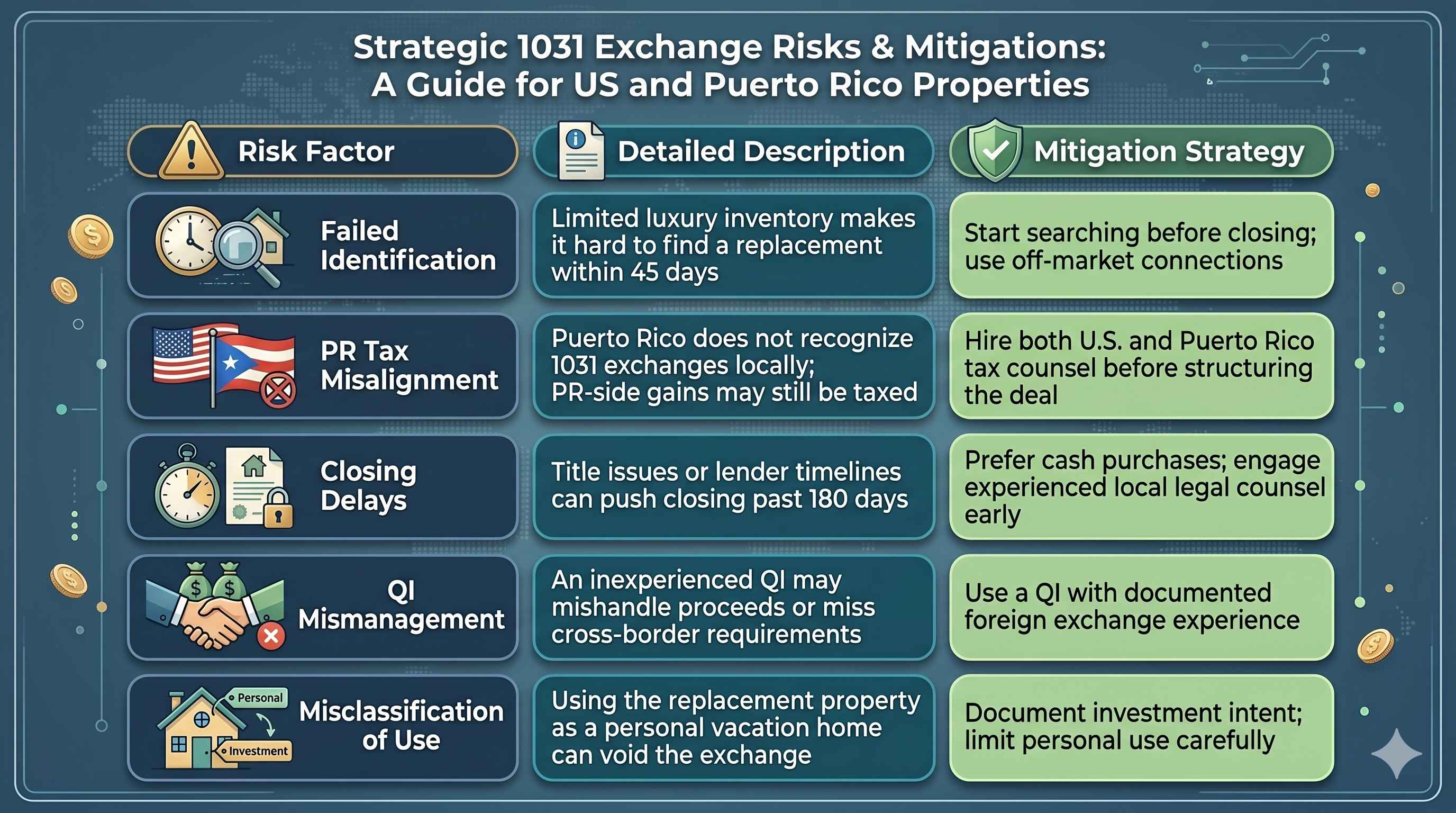
Failed Identification Due to Luxury Market Illiquidity
Puerto Rico luxury properties at the high end of the market, think $3 million and above in Dorado, Condado, or Bahía Beach, are not abundant. Inventory in these segments is limited, and off-market deals require relationships that take time to build. The 45-day identification window does not pause for slow-moving sellers or complex title situations.
- Begin your property search before closing on the relinquished asset, not after.
- Work with a brokerage that has direct access to off-market Puerto Rico luxury homes, since public listings alone may not give you enough options within the deadline.
- Have backup properties identified from day one, not just your top choice.
Cross-Jurisdictional Tax Misalignment
As noted, Puerto Rico does not recognize 1031 exchanges in its local tax code. If you are exchanging out of a Puerto Rico-based property and trying to defer both federal and local Puerto Rico taxes, you may defer the federal gain but still owe Puerto Rico income tax on the transaction. This asymmetry can significantly reduce the financial benefit of the exchange.
- Engage a Puerto Rico CPA alongside your U.S. tax advisor before structuring any exchange involving Puerto Rico real estate on either side of the transaction.
- Model out the full tax picture, federal and local, before deciding whether the exchange structure makes economic sense.
- Do not assume that a valid federal 1031 exchange automatically eliminates all tax exposure in Puerto Rico.
Financing and Closing Risks
Luxury property closings in Puerto Rico can take longer than expected due to title complexities, lender requirements for high-value properties, and occasional delays in local municipal records. Any closing delay that pushes past the 180-day window will disqualify the exchange.
- Use an all-cash purchase if possible to eliminate lender-related delays.
- Engage a Puerto Rico real estate attorney with experience in high-value closings from the start of the process.
- Build buffer time into your timeline and avoid identifying properties with known title issues.
Despite these risks, the potential rewards of this strategy are substantial for the right investor profile.
Potential Rewards of Investing in Puerto Rico Luxury Real Estate via a 1031 Exchange
Puerto Rico real estate investing, particularly at the luxury level, offers a combination of appreciation potential, rental income, and tax efficiency that is difficult to replicate in most other markets. When a 1031 exchange is structured correctly, investors can enter this market with deferred gains and position themselves for compounding returns over time.
Portfolio Upgrade Into a High-Demand Luxury Market
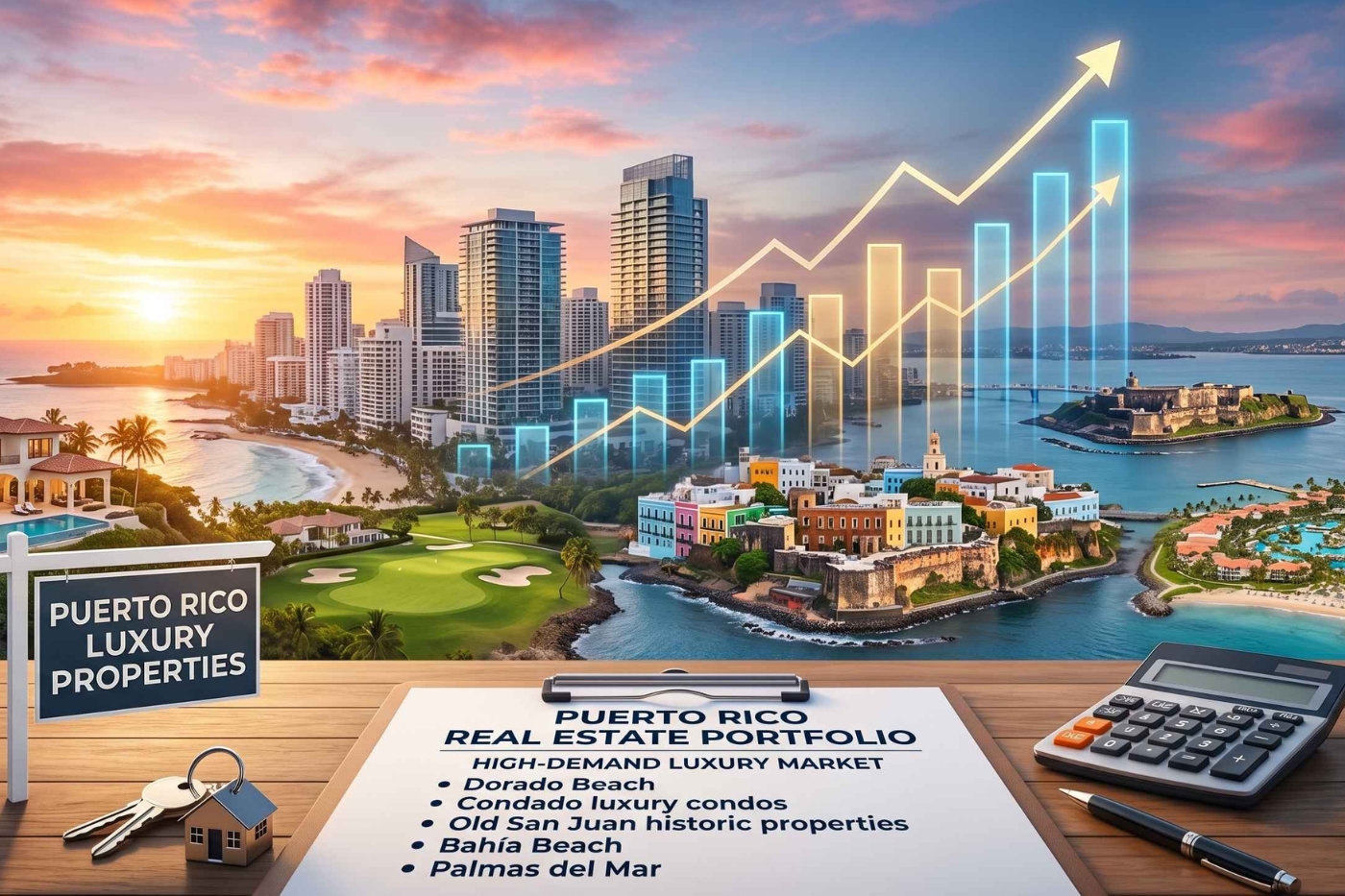
The Puerto Rico luxury real estate market has shown consistent strength at the top end. The Puerto Rico luxury real estate market has shown consistent strength at the top end, with seven‑figure properties in Dorado, Condado, and Old San Juan continuing to attract demand from U.S. mainland buyers, Latin American investors, and Act 60 relocators. Demand from U.S. mainland buyers, Latin American investors, and Act 60 relocators continues to support prices in Dorado, Condado, and Old San Juan.
- Dorado Beach properties offer resort-level amenities, private beach access, and strong short-term rental demand from high-net-worth travelers.
- Condado luxury condos appeal to urban buyers seeking walkability, proximity to financial districts, and established infrastructure.
- Old San Juan historic properties attract buyers seeking unique architectural assets with cultural and heritage value.
- Bahía Beach and Palmas del Mar offer gated community living with golf, marina access, and privacy.
Cash Flow and Appreciation Upside
Puerto Rico luxury homes in the right locations generate meaningful short-term rental income, particularly given the island's year-round appeal to U.S. travelers who do not need a passport to visit. Appreciation in top-tier micro-markets has outpaced many comparable U.S. coastal markets over the past five years.
- Many luxury villas in Dorado and Rincón target short‑term rental demand, especially during peak winter travel months, and can generate meaningful income when properly managed.
- New construction inventory remains limited, which supports pricing power for existing luxury properties.
- Infrastructure investment and continued Act 60 migration are attracting high-income residents to the island, supporting long-term demand.
Tax Deferral Stacking With Act 60
Perhaps the most compelling reward is the ability to combine a valid 1031 exchange deferral with Act 60 residency benefits. An investor who defers a large capital gain through a foreign-to-foreign exchange and then establishes Puerto Rico residency can potentially build future appreciation in a zero-capital-gains-tax environment at the Puerto Rico level. This is not a loophole; it is a deliberate intersection of two legitimate tax frameworks that rewards long-term, committed investors.
- The deferred federal gain from the 1031 exchange does not vanish, but it is pushed to a future date that you can control through holding period decisions.
- New appreciation on the Puerto Rico property, accruing after Act 60 residency is established, may qualify for 0% Puerto Rico capital gains treatment.
- Investors who plan to hold the property for 10 or more years and live in Puerto Rico as bona fide residents stand to benefit the most from this combination.
- Before committing capital, it helps to see what the current Puerto Rico luxury real estate inventory actually looks like at the high end.
Puerto Rico Luxury Properties for Sale
Christie's International Real Estate Puerto Rico gives investors direct access to the island's most exclusive luxury properties for sale, including off-market opportunities that never reach public listing platforms. Whether you are structuring a 1031 exchange or making a direct acquisition, Christie's International Real Estate Puerto Rico combines deep local market knowledge with the global reach of the Christie's network to help you find and close on the right asset. Here are a few current listings worth your attention.

49 Los Lagos, Humacao, PR 00791
This property sits within one of Humacao's most sought-after residential communities, offering privacy and natural surroundings at a compelling price point. It presents a strong investment case for buyers seeking long-term appreciation in Puerto Rico's eastern corridor.

17 Calle Durazno, Urbanización San Patricio, Guaynabo, PR 00968
Located in the prestigious San Patricio neighborhood of Guaynabo, this property offers proximity to San Juan's top schools, business districts, and luxury retail. It appeals to Act 60 relocators and high-net-worth families seeking a refined residential base.

201 Tetuan St, San Juan, PR 00901
This Old San Juan address places you at the center of Puerto Rico's most architecturally rich and historically significant neighborhood. The property carries strong short-term rental potential and long-term value as a rare urban luxury asset.
.jpeg)
1 Colina Linda – "Tranquilo," Rincón, PR 00677
"Tranquilo" in Rincón is a private hilltop estate offering panoramic ocean views and the kind of seclusion that high-net-worth buyers seek when relocating to Puerto Rico's west coast. This property suits investors targeting premium vacation rental income alongside long-term capital appreciation.
Final Thoughts
A 1031 exchange can be used for Puerto Rico luxury real estate only when the relinquished property is also classified as foreign real estate. Investors must carefully manage the 45-day identification rule, 180-day closing window, qualified intermediary requirements, and Puerto Rico’s separate tax treatment. With the right legal, tax, and real estate guidance, Puerto Rico can offer strong rewards through luxury property appreciation, rental income, and Act 60 planning.
Looking to buy, sell, or rent luxury properties in Puerto Rico? Christie's International Real Estate Puerto Rico helps high-net-worth investors identify premium properties that align with tax strategy, lifestyle goals, and long-term value. Connect with our team today to explore Puerto Rico luxury properties suited for direct acquisitions, investment planning, and qualified exchange strategies.
FAQs
Does Puerto Rico’s “foreign” classification apply to all 1031 exchanges, even if I’m a U.S. citizen?
Yes. The rule is based on where the real property is located (U.S. vs. foreign) under IRC §1031, not on the taxpayer’s citizenship or residency.
Can I use a Delaware Statutory Trust (DST) or other fractional interest to complete a Puerto Rico replacement?
Only if the interest you acquire is treated as an interest in foreign real property for 1031 purposes; many packaged 1031 offerings are U.S.-property-based, so eligibility depends on the underlying real estate and structure.
What due diligence items commonly derail Puerto Rico luxury closings within the exchange window?
Buyer-side issues often include HOA/condominium document review, short-term rental restrictions, insurance availability/costs (including wind/flood), and property condition findings that trigger renegotiation or repair timelines. For the IRS position, review Revenue Ruling 2005-25.






.png)


