


A luxury property held under an Act 60 decree does not automatically disappear from your estate when you die, nor does it pass to whoever you assumed would inherit it. Its transfer depends on how you hold title, Puerto Rico's forced-heirship rules, the property's registration status, your legal domicile, and whether U.S. federal estate tax applies to the asset.
In transactions involving luxury properties in Puerto Rico, unresolved succession documents and incomplete Property Registry updates can delay a seller’s ability to deliver recordable title, often pushing a proposed sale timeline beyond what buyers initially expect. This article examines the estate-planning decisions that affect a luxury property in Puerto Rico after the owner's death.
Key Takeaways
- Act 60 does not remove a Puerto Rico property from your estate.
- Puerto Rico generally reserves 50% of an estate for forced heirs.
- Post-2026 Act 60 residence rules limit eligible ownership structures for new applications.
- Puerto Rico has no local estate-transfer tax, but U.S. federal estate-tax analysis may still matter.
- Heirs usually need registry-ready succession documents before they can close a sale.
Your Puerto Rico Luxury Property Passes Through Your Estate Unless a Valid Planning Structure Directs Otherwise

A luxury home in Puerto Rico transfers based on how title is held on the day you die, not on your intentions or your mainland will. Property titled in your individual name flows into your Puerto Rico estate and becomes subject to local succession law and, in most cases, a probate-style court process before heirs can sell or refinance.
A properly drafted and funded trust may reduce some estate-administration friction, but whether it avoids court involvement or registry complications depends on the trust terms, Puerto Rico law, title records, and the decedent’s overall succession plan.
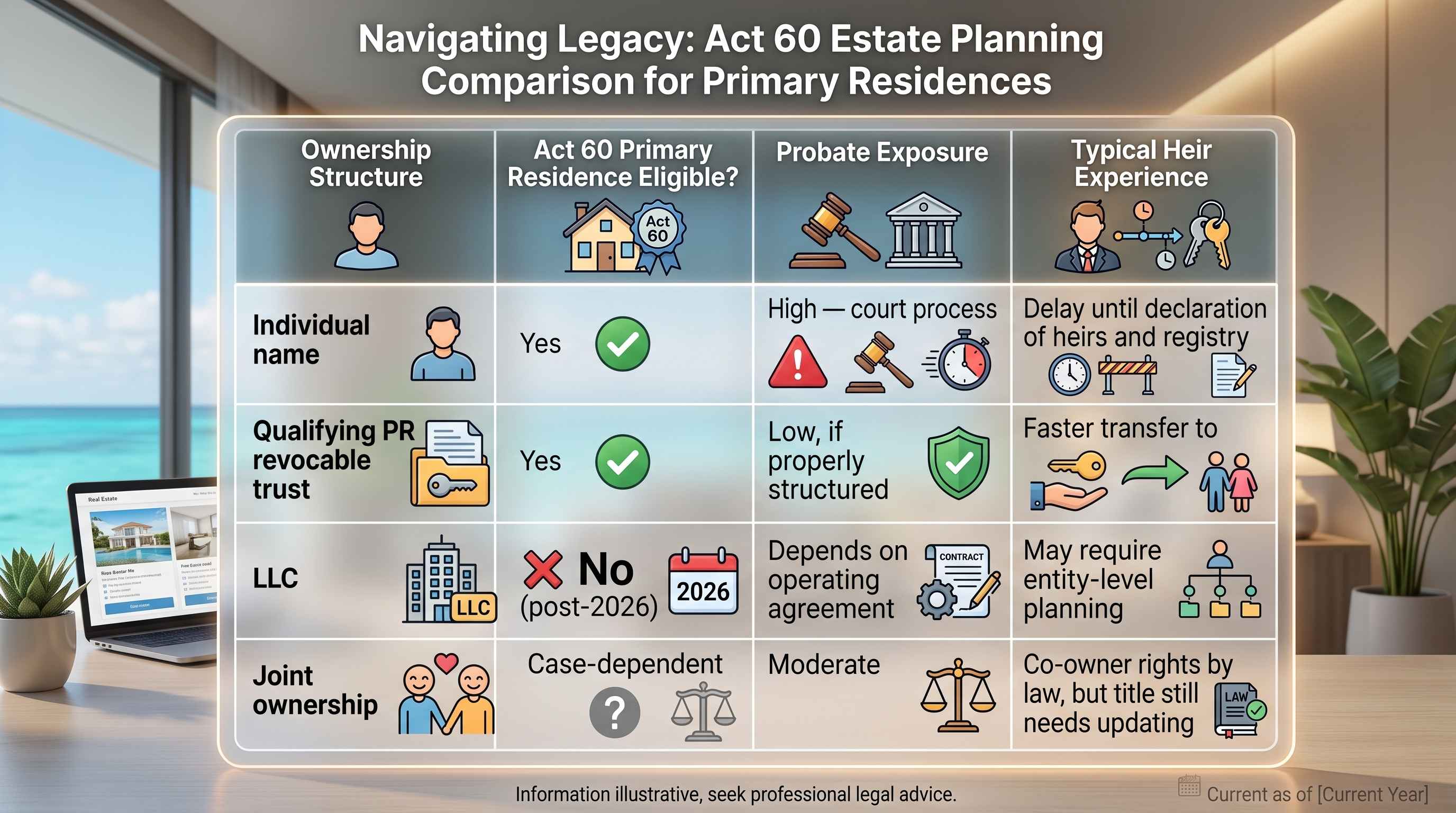
Ownership Structures and What Happens at Death
- Individual ownership: Property enters the decedent's estate directly and typically requires a declaration of heirs before any transfer.
- Qualifying revocable trust: May allow the property to pass to named beneficiaries without a full local probate proceeding, if properly structured under Puerto Rico law.
- LLC ownership: No longer satisfies the Act 60 primary residence requirement under the 2026 amendments to the Resident Individual Investor program, though it can still apply to investment properties.
- Joint ownership: Surviving co-owners may hold rights by operation of law, but title still needs updating in the registry before a sale can close.
Liquidity is the piece buyers underestimate. A property stuck in an unresolved estate cannot be mortgaged, and in most cases cannot be sold, until the registry reflects the correct owner, which means heirs sometimes carry property tax and insurance costs on a house they can't yet touch.
Puerto Rico's civil-law heritage shapes nearly every estate decision that follows.
Puerto Rico's Forced Heirship Rules Reserve Half Your Estate for Legitimate Heirs

Puerto Rico’s 2020 Civil Code generally reserves one-half of an estate for forced heirs, while the remaining half is generally available for free disposition. The family members entitled to protection, and the effect on a particular residence, depend on the owner’s family structure, marital-property regime, will, trust documents, and the assets available elsewhere in the estate. The 2020 Revision of the Puerto Rican Civil Code provides a scholarly explanation of the Code’s succession-law changes.
For a Puerto Rico luxury property, the practical concern is not simply whether the home is in an owner’s individual name. It is whether the overall estate plan accounts for Puerto Rico succession rules, identifies who will have authority to act after death, and gives heirs a workable path to obtain recordable authority to sell, refinance, partition, or retain the property. Owners using a mainland will or revocable trust should have Puerto Rico estate-planning counsel review the documents before relying on them to govern a Puerto Rico property transfer.
The 2026 rules on how you must hold your primary residence directly affect estate planning.
Act 60 Decree Holders Must Hold Their Primary Residence Directly or in a Qualifying Revocable Trust

For Individual Resident Investor applications filed on or after January 1, 2027, Act 38-2026 limits how a required Puerto Rico primary residence may be held for compliance purposes. The applicant must provide evidence of full title to a residence that is registered or pending registration with the Puerto Rico Property Registry and held in the individual’s name, jointly with the individual’s spouse, or through a grantor trust covered by the Incentives Code.
Act 38-2026 created two different timing paths for Individual Resident Investor decrees. Applications filed by December 31, 2026 generally remain under the prior 0% Puerto Rico tax treatment for eligible interest, dividends, and certain post-residency capital gains through December 31, 2035. Applications filed after December 31, 2026 are generally subject to a 4% Puerto Rico rate on those categories through December 31, 2055. Existing and pending decree holders may have options to request an extension or modification, but an extension can change the applicable tax rate and should be reviewed with Puerto Rico tax counsel before filing.
The ownership requirement matters for succession because it forces an early decision: who inherits the home, and whether the trust structure will survive in a way the Property Registry recognizes. Buyers who acquire a primary residence soon after receiving a decree should revisit title, registration, and estate-planning documents with Puerto Rico counsel rather than assuming the purchase structure remains suitable for every legal and tax purpose.
- Property must be the decree holder's actual main home, not a rental or secondary residence.
- For applications filed on or after January 1, 2027, the required primary residence must be held in the individual’s name, jointly with the individual’s spouse, or through a grantor trust covered by the Incentives Code, with the property registered or pending registration in the Puerto Rico Property Registry.
- A residence held through an LLC or another legal entity should be reviewed before any title change, decree extension request, refinancing, or estate-planning transfer. The applicable Act 60 result can depend on when the decree application was filed, whether the decree is already approved, whether the required primary residence has been acquired and reported, and whether the owner seeks to extend the decree through 2055.
Tax exposure is where Act 60 planning and estate planning intersect.
Puerto Rico Has No Local Estate Tax, but Federal Estate Tax Can Still Reach Your Luxury Home
Puerto Rico repealed local estate and gift taxes for decedents who die and gifts made after December 31, 2017. Under Act 76-2017, inherited property is not subject to a Puerto Rico tax on the transfer of the estate. That does not mean an estate sale is paperwork-free: the executor or heirs may still need to file the required estate information return, address any outstanding Puerto Rico tax debts, and obtain the applicable Hacienda lien-cancellation documentation before a notary or Property Registrar can complete certain estate-related transfers.
U.S. federal estate-tax exposure is a separate issue. It depends on the owner’s citizenship, domicile, worldwide estate, marital status, deductions, asset situs, and how the property is owned. Act 60 primarily addresses Puerto Rico income-tax treatment; it should not be treated as a blanket exemption from U.S. federal estate tax. Owners with substantial estates should obtain advice from U.S. estate-tax counsel and a Puerto Rico CPA before relying on any tax conclusion.
For a high-value Puerto Rico residence, Act 60 status and estate planning answer different questions. Act 60 may affect Puerto Rico income-tax treatment and primary-residence compliance, while succession planning determines who has rights in the estate, how title can be transferred, whether heirs become co-owners, and whether the eventual seller can deliver recordable authority to convey the property.
Ownership structure carries downstream consequences, summarized below.
Paperwork is where Puerto Rico inheritance law often stalls out-of-state families.
Heirs Can't Sell or Refinance Until the Property Registry Reflects a Declaration of Heirs
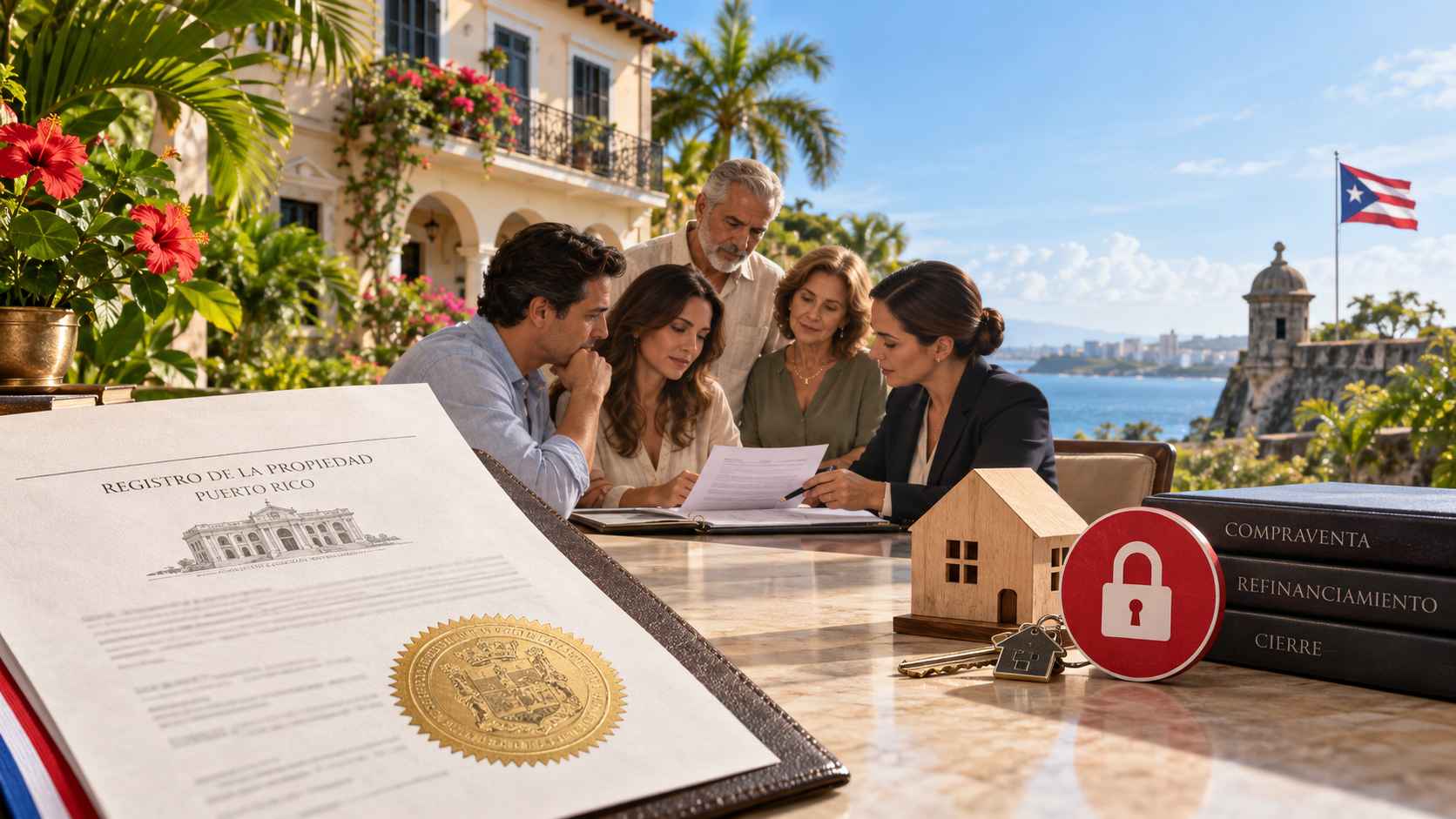
Before heirs can retitle or sell inherited Puerto Rico real estate, they typically need to confirm ownership through the Registro de la Propiedad and then obtain a court declaration of heirs, a formal judicial recognition of who inherits under law. If a person dies without a valid will, interested parties may petition Puerto Rico’s Court of First Instance for a declaratoria de herederos identifying the lawful heirs. The petition requires supporting records, commonly including a death certificate and a certification that no will is registered.
Puerto Rico registry law also requires recording hereditary rights before you can record certain partition deeds, conveyances, or liens involving inherited real property.
- Confirm current title status directly through the Puerto Rico Property Registry before listing an inherited property.
- Budget realistic time, often several months, for a declaration of heirs if one hasn't been obtained.
- Coordinate with a local notario or attorney early, since Puerto Rico closings run through notarial deeds rather than a title-company-only process common on the mainland.
These patterns show up repeatedly in our brokerage work, so we name them directly.
Recurring Title and Liquidity Issues We See in Luxury Transactions
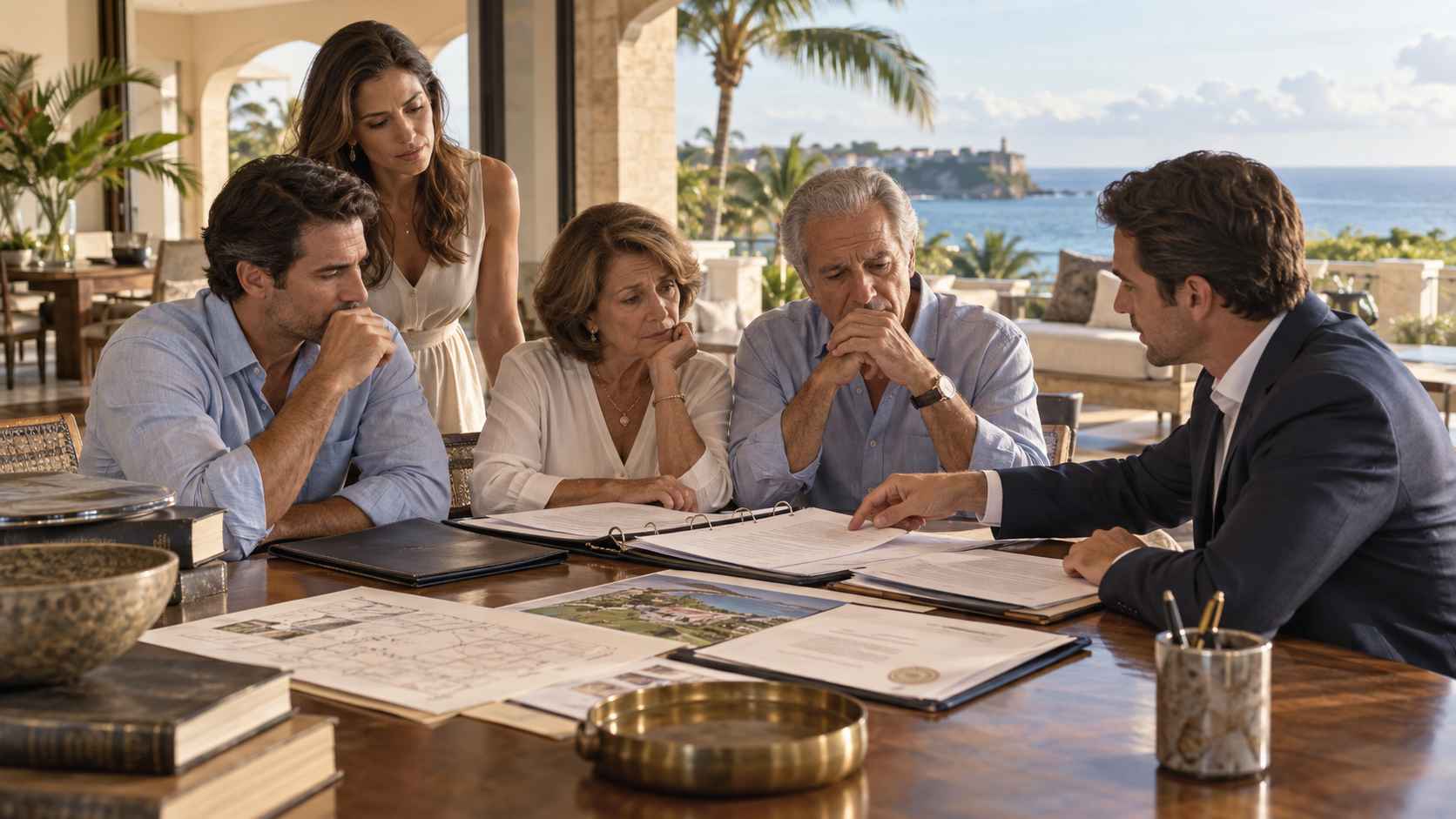
Estate-driven luxury sales in Puerto Rico commonly require early attention to registry status, succession documents, and decision-making among co-heirs. None are exotic, but each can add weeks or months to a transaction that a buyer's financing timeline usually can't absorb.
Common Friction Points
- Stale registry entries: A property purchased a decade ago under one ownership structure, never updated after a trust amendment or marriage.
- Mainland trust mismatch: A U.S. revocable living trust that was never re-papered to satisfy Puerto Rico's civil-law trust requirements.
- Multiple heirs, one house: Siblings who inherit as co-owners and disagree on listing price or timing, which stalls a sale indefinitely.
In estate sales, a signed offer does not eliminate the need for heirs to establish recordable authority to convey title. Buyers and lenders commonly require the succession and registry path to be resolved before closing. A delayed estate sale can narrow the buyer pool because purchasers with financing, relocation deadlines, or contingency periods may be unable to wait for unresolved succession steps.
A short pre-death checklist can save heirs real time and money.
An Attorney-Reviewed Checklist Before You Buy or Restructure a Puerto Rico Luxury Property

This checklist reflects points reviewed with a Puerto Rico estate-planning attorney and should not substitute for individualized legal or tax advice specific to your estate.
- Confirm current title status through the Puerto Rico Property Registry and resolve any outstanding liens or unrecorded transfers.
- Determine whether your Act 60 decree requires ownership in your individual name or a qualifying revocable trust, based on your decree date and the 2026 amendments.
- Review your estate plan against Puerto Rico's forced-heirship rules to see how much of the property is freely disposable versus reserved for legitimate heirs.
- Confirm whether your existing U.S. trust needs to be re-papered or supplemented with a Puerto Rico-law instrument to avoid local probate.
- Estimate potential U.S. federal estate tax exposure with a CPA familiar with Act 60 and Puerto Rico-situs assets.
- Document a clear succession plan for co-owned property if multiple heirs will inherit jointly.
The points above are informational, not legal or tax advice. Speak with a licensed Puerto Rico estate-planning attorney and a CPA experienced in Act 60 investor decrees before finalizing any ownership or trust structure.
None of this changes the appeal of owning here, only how carefully you set up ownership from day one.
Puerto Rico Luxury Properties for Sale
Getting the ownership structure right from the start is one reason to work with a team that understands both the market and the paperwork. Christie's International Real Estate Puerto Rico pairs deep local knowledge of Dorado, Condado, and Old San Juan with the global Christie's network, and our specialists routinely coordinate with estate attorneys before closing on high-value properties.
Below are current luxury properties for sale that reflect the caliber of homes where these estate-planning conversations matter most.
.jpeg)
200 Dorado Beach Drive #2210, Dorado, PR 00646
This oceanfront residence sits within the exclusive Dorado Beach community, offering direct beach access and resort-style amenities. View the full listing for layout details and pricing.

425 Sol St #Penthouse, San Juan, PR 00901
This Old San Juan penthouse combines historic architecture with modern finishes in one of the island's most walkable luxury districts. See the penthouse listing for more on its rooftop space and city views.

3 La Quinta Melones Beach, Barrio Flamenco, Culebra, PR 00775
Set on Culebra's Melones Beach, this property offers a rare combination of privacy and beachfront exposure on one of Puerto Rico's most sought-after small islands. Review the property details for acreage and access information.

3307 Ave Isla Verde Unit: PH, Carolina, PR
This exquisitely furnished beachfront penthouse offers panoramic ocean, lagoon and city views, expansive terraces, a gourmet kitchen, wine cellar and private parking near San Juan’s finest dining and entertainment.
Learn more about how Christie's PR built its reputation on our Our Story page, or see what sets the firm apart on Our Advantage. For estate-planning-adjacent market resources, visit our resources page, and reach out through Contact Us to speak with a specialist before your next purchase or sale.
Conclusion
Act 60 can shape your Puerto Rico tax position, but it does not replace succession planning. How your home is titled, registered, and allocated under Puerto Rico’s forced-heirship rules can determine whether heirs can keep, refinance, or sell it without major delays. Before buying or restructuring a high-value home, coordinate Puerto Rico estate counsel, tax counsel, and your real-estate team.
Whether you plan to buy, sell, or rent a luxury home, Christie's International Real Estate Puerto Rico can help you navigate the market with local insight. Our team connects clients with the right professionals while supporting a smoother, better-informed transaction. Speak with a Christie’s Puerto Rico specialist to explore your next opportunity.
FAQs
Do my heirs need U.S. documents “apostilled” or translated to use them in Puerto Rico?
Often yes. Death certificates, wills, trust papers, and court orders issued outside Puerto Rico may need an apostille (or other authentication), certified translations into Spanish, and Puerto Rico-specific notarial formatting before they’re accepted for recording or used in a closing.
What happens if the property has an outstanding mortgage, HOA balance, or property tax bill at death?
Those obligations don’t vanish. The estate or heirs typically must keep payments current to avoid default, liens, or collection actions, which can complicate timing and proceeds if the plan is to sell the home.
Can heirs list the home immediately, even if title hasn’t been updated yet?
They can market it in some cases, but most buyers and lenders will require the seller to have clear, recordable authority to convey title before closing—so the practical ability to close usually hinges on having the right estate documents and a registry-ready path to transfer.





.png)


.png)


