Yes, luxury Airbnb hosts in Puerto Rico need licenses, registrations, and tax compliance before accepting a single guest. The obligations span state-level registration with the Puerto Rico Department of Tourism, municipal permits, HOA clearance, and the 7% room occupancy tax. This guide walks through every requirement that matters at the luxury level, including staffed villas, event hosting, concierge services, and multi-unit portfolios.
Key Takeaways
- Luxury Airbnb hosts in Puerto Rico must obtain a tourism operating license before accepting any guests.
- Municipal business licenses and local STR ordinances apply in addition to state-level registration.
- Zoning rules and HOA or condo bylaws can override state permissions and block short-term rentals.
- Hosts are responsible for collecting and remitting Puerto Rico room tax, even when platforms help with withholding.
- Act 60 investors and multi-property operators need legal and tax advisors to keep luxury STR portfolios fully compliant.
Licensing and Registration Requirements for Luxury Short-Term Rentals in Puerto Rico

Puerto Rico requires all short-term rental operators, including those running luxury Airbnb properties, to register formally with the government and obtain an operating license before accepting guests. The Puerto Rico Tourism Company classifies most STR hosts as hoteliers under local law, which means the registration process mirrors what a small hotel would go through.
- This is not a formality you can skip, and enforcement has grown stricter as the legislature pushes for tighter Puerto Rico STR compliance across the island.
The Puerto Rico Senate has approved measures requiring all short-term rental properties to register with their municipality, submit tax and permit information, declare guest capacity, and obtain an operating license. These requirements apply to luxury properties just as they apply to budget listings, though the stakes at the high end are considerably higher given the nightly rates and guest expectations involved.
State-Level Registration With the Puerto Rico Tourism Company
The Puerto Rico Department of Tourism registration process requires hosts to formally register their property and operate under a tourism license. You will need to present documentation that establishes your legal right to operate the property as a short-term rental. This step is non-negotiable for any host collecting payment from guests.
Key documents and steps for state-level registration typically include:
- Proof of property ownership or a lease that permits subletting.
- A completed tourism registration application with the Puerto Rico Tourism Company.
- Declaration of guest capacity and room count.
- Proof of a bond insurance policy, which protects guests and covers liability.
- Merchant registration with Hacienda (Puerto Rico’s Treasury Department) to obtain a Merchant’s Registration Certificate and to file applicable room tax and sales and use tax returns.
- A valid business entity registration if you operate under an LLC or corporation.
Timelines for approval can range from a few weeks to several months, depending on the completeness of your application and the current volume at the Tourism Company. Starting early is practical advice, not just caution.
Municipal Business Licensing and Local Permits
Beyond state registration, Puerto Rico Airbnb regulations require hosts to comply with their specific municipality's rules, which differ considerably from one town to the next. Municipalities like Dorado, which is home to some of the most sought-after Puerto Rico luxury real estate, impose additional permit requirements for short-term rental businesses operating within their jurisdiction.
The Puerto Rico legislature has considered measures to create a more uniform island-wide municipal STR registry and licensing framework. Until any such law takes effect, hosts must confirm the current rules in each municipality where they operate.
At the municipal level, expect to address:
- A municipal business license (patente municipal) from your local government.
- Fire safety inspection and certificate of occupancy.
- Sanitation inspection, particularly relevant for properties with pools, kitchens, or staff facilities.
- Land-use and zoning confirmation that short-term rental use is permitted on your parcel.
- In some municipalities, a specific STR operating permit is separate from the general business license.
Puerto Rico municipal STR ordinances are not always published in one convenient place (for example, the Municipality of San Juan has enacted its own STR ordinance). Calling your municipal planning office directly or having a local attorney do it on your behalf saves time and prevents costly assumptions.
Zoning and Land-Use Compliance
Zoning compliance is a layer that luxury hosts often underestimate, particularly when purchasing a property specifically for short-term rental income. A property zoned for residential use may not automatically permit commercial hospitality operations. A luxury villa offering concierge services, private chef arrangements, or event hosting may cross into commercial territory under local zoning codes.
Getting a zoning opinion from a Puerto Rico attorney before you buy or list is a step worth taking seriously. Common zoning issues that affect luxury STR operators include:
- Residential-only zoning that bars commercial use, even for occasional rentals.
- Event hosting restrictions that limit gatherings above a certain guest count.
- Noise ordinances and curfews that affect properties marketed for celebrations or destination events.
- Parking requirements tied to the number of guests or rooms offered.
Moving on from zoning, the rules inside a building's governing documents can be even more restrictive than what the municipality requires.
Condominium and HOA Rules That Affect Puerto Rico Luxury Properties

For luxury Airbnb Puerto Rico operators who own units in condo buildings or gated communities, the master deed, bylaws, and restrictive covenants carry significant legal weight. If those documents prohibit short-term rentals or define them as commercial use, you cannot legally operate an STR regardless of what state or municipal law permits.
- Communities in Puerto Rico are expressly authorized to adopt stricter internal rules than state law, which means HOA restrictions can be tighter than anything the Tourism Company or municipality requires.
Before purchasing a luxury condo or villa within a managed community for STR purposes, you need written confirmation, not verbal assurance, that short-term rental use is permitted. This is a step that experienced buyers of Puerto Rico luxury real estate take before closing, not after.
What to Review Before You List a Luxury Condo
- The master deed and declaration of horizontal property regime.
- Current HOA bylaws and any amendments passed in recent years.
- Any board resolutions specifically addressing short-term rentals.
- Rental frequency limits, such as minimum stay requirements or maximum rental days per year.
- Guest registration requirements imposed by the building.
- Rules on amenity access for short-term guests versus permanent residents.
- Liability and insurance requirements the building places on STR operators.
Puerto Rico condo Airbnb rules have tightened in several high-end buildings as permanent residents push back against the impacts of frequent guest turnover. Assuming a building allows STRs because other units appear on Airbnb is a common and expensive mistake.
Now that the legal and structural requirements are clear, the tax obligations deserve the same level of attention.
Tax Obligations Every Luxury Host Must Meet
Puerto Rico's room occupancy tax under Act 272-2003 is generally 7% on eligible short-term rental stays, separate from sales and use tax obligations. A portion of this room tax is allocated to municipalities, and hosts should confirm the current distribution and filing requirements with the Puerto Rico Tourism Company and Hacienda.
Hosts who fail to collect and remit this Puerto Rico tourism tax correctly face back taxes, interest, and penalties that can be substantial, given the high average daily rates that luxury properties command.
Here is a summary comparison of the main tax and compliance obligations at different levels:
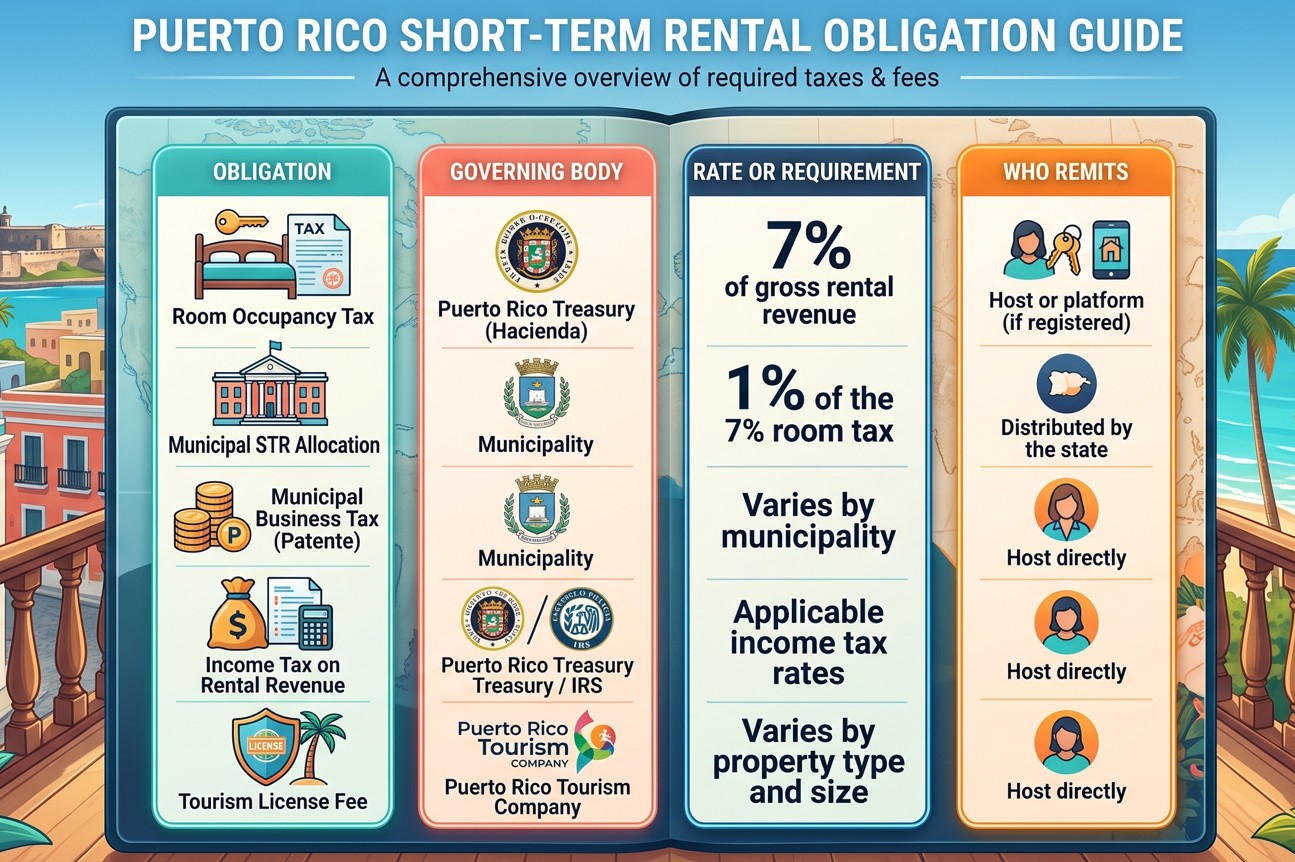
Platforms like Airbnb may withhold and remit room tax on eligible bookings once the host is properly registered, but this does not replace the host’s duty to file room tax declarations with the Puerto Rico Tourism Company and pay any outstanding amounts. The underlying tax obligation remains with the host, not the platform.
Act 60 Tax Incentives and STR Compliance
Many luxury property investors in Puerto Rico operate under Act 60 tax incentives, which offer significant income and capital gains tax benefits for qualifying residents. Mixing Act 60 benefits with STR income requires careful structuring, because rental income treatment under Act 60 depends on how the activity is classified and how the property is held. A tax advisor familiar with both Puerto Rico real estate and Act 60 is not optional at this level, it is essential.
Key considerations for Act 60 holders running luxury STRs:
- Confirm whether STR income qualifies as passive or active income under your Act 60 decree.
- Understand how the 7% room tax interacts with your overall tax structure.
- Keep STR operations clearly documented and separate from personal use of the property.
- Review your decree terms before adding STR activity, since some decrees have specific restrictions.
With taxes and incentives covered, enforcement realities are the final piece that every serious host needs to understand.
Enforcement, Penalties, and Why Compliance Is Getting Stricter

Policy studies and legislative discussions confirm that STRs now cover a significant share of Puerto Rico's housing stock, yet historically, only a fraction registered and paid the room tax. That gap has drawn the attention of legislators, municipalities, and Hacienda, all of whom are actively working to close it. For luxury Airbnb Puerto Rico operators, the risk of enforcement is real, and the financial exposure at high nightly rates makes non-compliance especially costly.
Penalties for operating without proper Puerto Rico rental permit requirements in place can include fines, forced closure of the listing, back taxes with interest, and in repeat cases, legal action. Some municipalities have begun active inspection programs targeting unregistered STRs, and platforms increasingly cooperate with government data requests. Read the STR impact study.
Common Compliance Mistakes Luxury Hosts Make
- Listing a property before completing Tourism Company registration.
- Assuming the platform remits all taxes without confirming registration status.
- Skipping the municipal business license because the state registration feels sufficient.
- Failing to verify HOA or condo restrictions before purchasing or listing.
- Not updating permits when adding services like concierge, event hosting, or additional units.
- Ignoring zoning changes that may reclassify a property's permitted uses.
- Operating under an expired tourism license without renewal.
Practical Steps to Stay Compliant
- Engage a Puerto Rico attorney with STR and real estate experience before you list or purchase.
- Complete Tourism Company registration and obtain your license number before your first booking.
- Register with Hacienda as a merchant and set up room tax collection and remittance from day one.
- Apply for your municipal business license and schedule required inspections.
- Request written HOA or condo board confirmation that STR use is permitted.
- Obtain a zoning opinion if your property offers event hosting or concierge-level services.
- Review and renew all permits annually, and monitor legislative changes that may affect your operation.
Puerto Rico STR compliance is not a one-time checklist. The regulatory environment continues to shift, and what applied last year may carry new requirements today. Staying current means checking in with a local attorney at least annually, especially as Senate Bill 238 and similar measures move through the legislature.
With the compliance picture clear, the next natural question for serious investors is where the best luxury STR opportunities actually sit in the Puerto Rico market.
Puerto Rico Luxury Properties for Sale
Christie's International Real Estate Puerto Rico works with investors, buyers, and sellers across the island's most desirable markets, from Condado to Dorado to Old San Juan, offering the kind of market depth and discretion that luxury property transactions require. If you are searching for luxury properties for sale or evaluating Puerto Rico luxury homes as long-term investments with STR income potential, Christie's PR brings the global network and local expertise to find the right fit.
Here are a few featured listings worth exploring:

152 Tetuan St, San Juan, PR 00901
This Old San Juan property sits in one of the most historically significant and sought-after addresses in Puerto Rico, offering strong STR demand driven by cultural tourism and walkable access to the city's finest dining and landmarks. Its location within a UNESCO-recognized historic zone makes it a distinctive asset for investors targeting high-ADR short-term rental income.

A Street Villa Caparra #A-13, Guaynabo, PR 00966
Located in the prestigious Villa Caparra community of Guaynabo, this property offers a refined residential setting with proximity to San Juan's business and luxury corridors. It presents a compelling option for buyers interested in Puerto Rico luxury real estate with both personal use and rental income potential.
.jpeg)
904 Villa Dorado Estates, Dorado, PR 00646
Dorado continues to lead Puerto Rico's luxury market, and this Villa Dorado Estates property places you at the center of one of the island's most exclusive residential enclaves. The address carries strong STR appeal for high-net-worth travelers seeking privacy, resort-level amenities, and proximity to Dorado Beach.

Lot 4 IBIZA ST, RD 107 KM 2.7 AGUADILLA PR, 00603
A rare cliffside oceanfront estate in Aguadilla offering panoramic Atlantic views, unforgettable sunsets, Santorini-inspired design, an infinity pool, direct access to a secluded beach, and proven luxury short-term rental performance.
Final Thoughts on STR Licensing for Luxury Hosts
Operating a luxury short-term rental in Puerto Rico is only sustainable when licensing, zoning, HOA, and tax obligations are fully in order. Proper registration with the Tourism Company, Hacienda, and your municipality protects both your revenue and your property’s long-term value. Treat compliance as part of the investment thesis, not an afterthought, especially at the luxury level.
Buyers, sellers, and owners who want to maximize the potential of their luxury properties in Puerto Rico benefit from expert guidance at every step. Christie's International Real Estate Puerto Rico combines local regulatory insight with a global network to help you structure purchases, sales, and rental strategies around compliant, profitable STR operations. Connect with their bilingual team to explore Puerto Rico luxury properties, align your licensing plan, and position your asset for high-end Airbnb demand.
FAQs
Do I need a separate license if I offer add-ons like a private chef, chauffeur, spa services, or yacht charters?
Often, yes. Once you move beyond lodging into “tour services” or vendor-managed experiences, you may need additional contracts, vendor licensing verification, and stronger liability coverage—especially if you market the services under your brand. Confirm with counsel whether you’re acting as a referral platform, reseller, or direct provider.
What extra compliance should I plan for if I host weddings, retreats, or other events at the property?
Event use commonly triggers additional requirements such as assembly/occupancy limits, amplified-noise rules, parking/traffic plans, security staffing, and special event permits. You should also update your insurance (event liability, liquor considerations, hired security) and use event-specific contracts with indemnities and neighbor/HOA acknowledgments.
How should I handle compliance when I manage multiple luxury STRs under one company?
Create a portfolio compliance system: a permit/license tracker with renewal dates, property-by-property tax and payout reconciliation, standardized guest screening and incident reporting, and documented SOPs for staff/contractors. Many operators also separate ownership and management entities to reduce liability and simplify accounting across municipalities and HOAs.


.png)



.png)